Showing posts with label Thailand. Show all posts

Tuesday, 3 January 2012

Flooding brings grief to more southern provinces Tens of thousands of homes are inundated

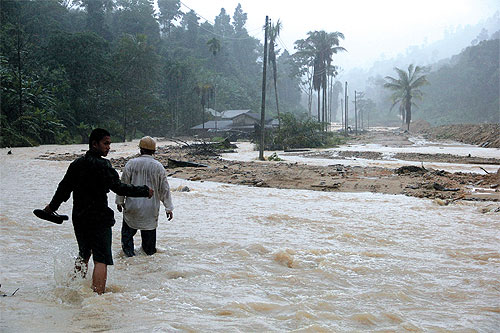
People wade through run-off sweeping through Ban Phian village of tambon Thepharat in Sichon district of Nakhon Si Thammarat province yesterday.

As floodwater started receding in the four southernmost provinces, the flooding expanded to four other provinces yesterday.

Residents in some areas were put on high alert for mudslides triggered by torrential rains which have pelted the South during the past three days.

The floods have inundated tens of thousands of homes, forcing residents to seek shelter elsewhere and causing significant economic damage.

Nakhon Si Thammarat, Chumphon, Trang and Krabi were the latest four provinces to be hit by flash flooding and mountain runoff triggered by heavy downpours.

Thousands of residents in mudslide-prone areas, including Nakhon Si Thammarat's Nop Phi Tham district, have been evacuated to safe ground to prevent a repeat of last year's tragedy.

Mudslides hit the district in March 2011, killing several people.

But flooding in the southernmost provinces of Songkhla, Yala, Pattani, Narathiwat has eased and many affected areas have dried out. Officials said all would return to normal by today as long as the rains cease.

The continuing rain yesterday caused flash floods in three districts of Nakhon Si Thammarat, including Nop Phi Tham, Sichon, and Lan Saka.

Floodwaters cut off at least six bridges and roads in Nop Phi Tham district, leaving several villages isolated from the outside world, the Disaster Prevention and Mitigation Department reported yesterday.

Nop Phi Tham district chief Preecha Koomwong said tambon Krung Ching was the hardest hit area as floodwaters washed away temporary bridges built to replace the ones destroyed by last year's flash floods.

Mr Preecha said he feared there would be more flash floods and landslides if the rain continues this week.

In Sichon district, almost 200 families living in landslide-prone areas have been moved to evacuation centres after between 20 and 40cm of rain fell during the prior 24 hours.

Nakhon Si Thammarat governor Viroj Jiwarangsan said officials had been sent to disaster-hit areas to repair roads and bridges to enable the delivery of relief supplies.

Runoff from Banthad mountain also inundated some districts of Surat Thani, Trang and Phattalung provinces.

In 11 districts of Phatthalung, about 30,000 families' homes were flooded in tambon Kuan Saothong, where water reached two metres on Sunday night.

The waters began to recede yesterday afternoon.

Meanwhile, authorities have managed to contact the eight hikers who went missing during an excursion to Khao Lon mountain over the weekend. All of them were safe.

They said communication signals was down because of bad weather.

In Chumphon, Lang Suan Hospital in Lang Suan district was inundated yesterday afternoon. The water level rose rapidly, prompting medical staff to quickly move patients and medical equipment to higher floors.

In Thung Tako district, flash floods inundated a 200-metre section of Highway 41 linking Chumphon and Surat Thani yesterday, making it impassible to motorists, who had to use a bypass road instead.

The incident caused traffic congestion along the southern road which was already crowded with motorists returning home from the New Year holidays.

The Chum Phon-Lang Suan and Lang Suan-La Mae roads were also closed due to flooding.

Science and Technology Minister Plodprasop Suraswadi yesterday inspected Thung Wua Lan beach in Pathiu district which was damaged by high waves recently.

Mr Plodprasop said the ministry was planning to install a wave detection device to warn residents of high waves before they reach the shoreline.

He also ordered local authorities to take legal action against resort operators who have encroached on public beaches.

In other news, flooding in the southernmost provinces improved yesterday as the water quickly drained out to the sea.

Hat Yai's business district was spared from flooding, which affected only three communities in Hat Yai municipality.

Songkhla governor Grisada Boonrach said the Royal Irrigation Department has sped up the draining of water out of U-tapao canal.

He said the situation would return to normal shortly if there is no more rain, although authorities plan to keep a close watch for possible flooding today. On New Year's Eve, flash floods inundated the homes of more than 20,000 people in 12 districts of Songkhla, he said.

Public Health Minister Wittaya Buranasiri yesterday said three hospitals in Songkhla were slightly damaged by the floods. Three critical patients in flood-hit Sadao district were transferred to Hat Yai Hospital on Sunday.

In Pattani, floods receded in eight districts which were hit by flash floods over the weekend.

However, residents were told to stay on alert for more flooding, especially those near Pattani and Sai Buri rivers.

Residents in six coastal districts were also warned of high waves and turbulent seas today and tomorrow.

In Narathiwat, floodwater started receding in some parts of 10 affected districts.

Villagers living in landslide-prone areas were told to prepare for evacuation after five homes at the foot of mountains in Muang and Rueso were swept away by strong mountain runoff on Sunday, while 20 others were slightly damaged.

In Yala, floodwater receded in Muang, Raman, Bannang Sata, Krong Pinang, and Yaha districts. The water level of the Pattani River, which breached its banks and inundated a number of communities on Sunday, was also receding yesterday.

Saturday, 26 November 2011

Thai Facebookers get a new royal warning

BANGKOK, THAILAND: Facebookers in Thailand have got to be careful while posting or reacting to messages. 

A minister has warned them against 'liking' the posts that might be offensive to the monarchy. They can be prosecuted under the country's strict lèse-majesté laws.

This came two days after 60-year-old Amphon Tangnoppaku was sentenced to 20 years jail for sending sending text messages considered insulting to the queen.

The court said Amphon sent offensive text messages in May 2010 to a personal secretary of then-Prime Minister Abhisit Vejjajiva.

A report in the Bangkok Post quoted the information technology minister's statement asking Facebookers to delete all their reactions and comments to any matter related to the monarchy.

"If they don't delete them, they can end up violating the computer crime act for indirectly distributing inappropriate content," inuits said.

Wednesday, 23 November 2011

Thailand's annual GDP may shrink to 1.5% due to flood

Thailand's annual GDP is projected to drop in the fourth quarter due to repercussion from worst-flood in 50 year, Bangkok Post reported on Tuesday.

The Thai economy is projected to contract by 3.7 percent in the fourth quarter, down from a previous projection of 5 percent before the floods, depressing annual growth to 1.5 percent from the earlier projection of 3.5 percent to 4 percent, according to the National Economic and Social Development Board (NESDB).

The country's worst floods, caused by heavy monsoon and overflow from several dams in upper part of the country, in nearly 60 years has claimed more than 600 lives and affected about 10 million people since mid July.

A better outlook is projected for next year with 4.5 percent to 5.5 percent economic growth, the NESDB said on Monday.

The NESDB estimated the floods would damage the Thai economy by 2.3 percent, or around 200-300 billion baht (6.4 - 9.6 million U.S. dollars).

The figure is an initial projection, but the real impact depends on how quickly the government and companies can repair infrastructure and operations. 

Some have set a target of 45 days after the water recedes to resume production, except for the electronic sector, which will need up to six months.

The agency announced that the GDP growth of 3.5 percent in the third quarter, exceeding 2.7 percent in the second quarter and 3.2 percent in the first, supported by the recovery of industrial manufacturing after the tsunami in Japan. 

The GDP of the industrial sector in the quarter was 3.1 percent, rebounding from a contraction of 0.1 percent in the second quarter.

Export value rose 27.3 percent year-on-year and private investment and tourism also grew, said NESDB Secretary-General Arkhom Termpittayapaisith.

However, the floods caused a contraction by 0.9 percent in the agricultural sector, slicing 0.7 percent off overall economic growth in the third quarter.

For the initial nine-month period, the NESDB reported economic growth of 3.1 percent.

GDP value at current prices is projected at 10.66 trillion baht, down from a previous projection of 10.87 trillion. The projection is based on oil priced at 103-107 U.S. dollars a barrel.

The projection for investment growth this year was cut to 4.7 percent from 6.2 percent. Private investment is projected at 8.8 percent growth while government investment should contract by 7.9 percent.

Consumption growth is projected at 2.3 percent, down from 3.3 percent previously. Export growth is projected at 17.2 percent growth to 226.9 billion U.S. dollars and inflation at 3.8 percent.

He expects flood rehabilitation and the continued growth of Asian economies will contribute to the higher figures.

Risk factors are a delay in rehabilitation in both the industrial and household sectors, the euro zone debt crisis, oil prices and the government's ability to build a water management plan next year.

Saturday, 19 November 2011

Critical clean-up Ways in which to reuse sandbags after flooding

It's expected the flood situation will steadily improve and everything should be dry by mid-Dec. However, there is much clean-up work to do. 

Most notably, the dismantling of sandbag flood barriers and concrete walls. Muse asked what your thoughts were on how we should handle this job and what to do with all the sand and bags afterwards. Here are your answers.

Sand, for a start, comes in many grades, and not all grades are good for construction. However, the highest quality sand which hasn't been submerged for a long time can be used as raw material to make glass objects and bottles. 

The sand from each particular flood barrier should be reused to restore damaged public places, such as monasteries, schools, religious sites, roads and bridges in the vicinity. 

In addition, the inclusion of other building materials and supplies are also needed for each restoration project. 

It's also important that this process is carried out as soon as possible to prevent further deterioration of the quality of sand.

High quality sand that wasn't used or did not come into contact with contaminated water could still be used as soil and fertilizer. 

Also, the cloth, plastic and polythene sheeting from the sandbags can be pressed and used in land reclamation works, which is more Eco-friendly than other types of waste disposal materials.

Or the State could stage an auction for construction companies to bid for all the used materials.

But most of all, I hope managing the use of these materials will be conducted in the best interests of everyone in the community and the country, without any political agendas."

SOMWUT S.
Company employee

A natural disaster leaves a trail of property destruction, and many times it leaves thousands of its victims with a damaged sense of balance. 

In addition to restoring buildings and replacing material possessions, victims may need to devote time to restoring their own emotional equilibrium during the recovery period. This can be especially important for children who do not have years of life experience to guide them.

During a flood, all of our energy is directed towards saving our homes, our businesses, our communities. But what happens after the floodwater recedes? How do we cope with the damage that's been left behind?

Focusing on the present can help us work through many of life's setbacks, both big and small. Spending time wondering 'what could have been' or thinking about 'if only' will cause more stress because the situation is in the past and out of our control.

I would imagine that all the materials used to make flood barriers amounts to thousands if not millions of baht. So the question now is what are we going to do with it all when it's dry again?

We need to learn acceptance. So often, we worry about things that we cannot control. Face that fact. If we cannot control a situation or occurrence, then learn to accept that as a reality. Conserve our energies for the things we can control.

Some might think, 'Is the government responsible for the flood disaster?' If I may, 'yes', to some extent. If the government has any sense of responsibility I would suggest it offer to buy back (at a reasonable price) the sandbags and other materials and put it to good use. 

I imagine right now a lot of cement and sand is needed to rebuild all that has been destroyed by the massive flood.

Here are some ideas on what to do with used materials:

- Restore buildings, especially the foundations and those with major cracks on the walls

- Repair buckled walls and floors

- Build new homes for the flood victims

- Repair roads

- Reinforce flood-prone houses

- Repair canals, reinforce existing riverbank walls or build them higher

- Fix damage in condo basement and repair leaking basements

- Make tiles, pacers and bricks

- Cover holes and uneven walkways

Last but not least, donate all the sandbags and cement to charitable organizations that are helping flood victims to rebuild their homes. One of them is Habitat for Humanity."

MARY JOSEPHINE LEONG
Retired regional merchandising/sourcing manage

I think the most practical use for the sand and cement would be to construct much needed pavements in Bangkok that have sunk over time. Sand could be put in sandboxes for kids, while cement, when it's wet, would not be much use for anything.

Trying to resell the sandbags back to the companies where they were purchased is a sheer waste as they would buy them back for a mere pittance. 

Another constructive way to put them to good use would be to build walls around moo bans, apartment buildings, schools, etc., as well as raise the level of sub-sous, which are the first to flood after heavy downpour."

RACHEL BOONPRASERT
Kindergarten teacher

Next week: News of a secret Cabinet meeting that resolved to endorse a controversial royal pardon that could allow the return of fugitive ex-premier

Thaksin Shinawatra to be pardoned of all his misdeeds is indisputably the hottest headline of the week, which has even overshadowed the news of receding water levels.

Whether or not the decree will come to pass and effective is another matter, however. 'Muse' asks what your thoughts are on the cabinet resolution.

Send your answers along with name, address and profession to muse@bangkokpost.co.th by Nov 22 to compete for a special prize.

Tuesday, 15 November 2011

Flood overwhelms search engine


Top ten Search in Google Zeitgeist (week of Oct 8-14, 2011)

1. ThaiFlood.com
Thai people seeking up to date information on the floods look to ThaiFlood.com
2. Navanakorn Industrial Promotion Zone
Navanakorn Industrial Promotion Zone has flooded unable to withstand the strong flow of incoming flood waters
3. thai flood
Thais search for trusted news sources through the Internet and social networks
4. terminal 21
New shopping mall in Asoke-Sukhumvij creates a unique atmosphere brining elements from around the world into one place
5. nokia 700
Latest Nokia smartphone comes in a compact size with a touch screen
6. Eel
Latest fashion in social media is to show a customized eel picture when your internet crashes
7. Flooding 2011
Thailand bravely fights against flood waters, the worst floods the country has seen in the last 50 years
8. spring news
Keep on tracking flood situations via 3G TV online on Spring News channel
9. Flood Map
Thai people urgently seek information about areas at risk and how to stay safe
10. Movie: Billionaire teenager
11. http://thailandflooding.blogspot.com/ 
12. http://thaiflooding2011.blogspot.com/
The inspiring story of a Thai teenager who succeeds and becomes a young billionaire has been made into a movie and is now showing in cinemas

Asean members to cooperate in flood migitation and relief


Asean's leaders will agree to enhance cooperation in disaster risk management and mitigation as well as post disaster relief, recovery and rehabilitation in member countries when they meet in Bali later this week.

In a move initiated by Thailand, the 10 leaders will issue a statement on cooperation in flood prevention, mitigation, relief, recovery and rehabilitation after their summit on Thursday.

The statement, of which a draft has been seen by The Nation, calls for further cooperation among members, sharing best practices in disaster management and management of water resources.

Countries in the region, including Cambodia, Vietnam and notably Thailand have faced severe flood disasters. 

In Thailand alone, the biggest flood in 50 years has killed more than 500 people and displaced millions of others. Parts of Bangkok and the suburbs are now inundated.

How about helping with the post-flood cleanup?

Flooded homes need to be cleaned up to become liveable again, and many of them also need repairs, but the work may be too much for householders who do not have domestic staff to help them.

There are many popular sayings associated with home -- “Home sweet home”, “There is no place like home”, "Peace – that was the other name for home”, "Life’s voyage, which is homeward bound” and “Home is paradise” to give just a few.

But the current great flood has turned many homes upside down, making them unlivable and forcing tens of thousands of affected families to take refuge in temporary shelters provided by the government or charitable organizations.

The damage done to these properties varies from house to house, depending on how long they were flooded and how deep the water. In money terms the true cost may never be known, but it is certainly astronomical.

The 5,000 baht handout promised by the government for each flooded household is nowhere near the real cost to those households flooded for a long time. 

The families will have to dig deep into their pockets to pay the bills incurred in making their homes livable again. Many will have to seek loans from a bank or from a loan shark if they don’t have credit worthiness.

But the first priority for all affected residents is to clean up their flooded houses to make them livable, at the least, even if they cannot restore all the comforts and conveniences they used to enjoy.

The immediate cleanup includes washing away all the dirt that came with the floodwater, mopping or scrubbing the floor, scrubbing the walls, moving furniture and appliances such as refrigerators outside so they can dry out in the sun, and hopefully be usable again. 

It's a daunting undertaking which may take more than just a few days.

Large families and those with maids and other household help will find the job less taxing, but for singles or married couples without any helpers it will be a very demanding task.

Outside help would make the job easier, but the problem is that few people would trust strangers into their homes to do the cleanup.

The extraordinary volunteer spirit shown by many young men and women during the flood - in the ways they helped fill and place sandbags, package and distribute relief supplies to flood victims could also play a role in the cleanup effort after the flood has receded.

It would be a great pity that this spirit is also allowed to flow away as the water recedes, because the hardship is not over for the flood victims.

Obviously, the government and state agencies have thought about helping in the cleanup, but they appear to be far more concerned with other rehabilitation and reconstruction jobs which are deemed more important. That does not mean that they cannot offer a helping hand.

It is an additional but very rewarding job which would be greatly appreciated by the affected households. The question is, which agency is going to organize the effort?

At a less complicated level, this can be done by employers as part of the corporate social responsibility programmer, and there must surely be several employees whose houses are flooded in each company.

It could be given a name like “friends help friends” - a programmer under which office workers who escaped the ravages of the flood could help their affected fellow workers in the cleanup of their homes. 

This would provide a good opportunity for employees to get closer to one another and to become friends instead of just being office colleagues.

The goodness of ordinary Thais, which was shown in their spontaneous outpouring of compassion and willingness to pitch in a help, should be kept alive a bit longer.

They have yet another undertaking to fulfill – to help with the cleanup, so our less fortunate compatriots can once again enjoy going "home".

Monday, 14 November 2011

Don Muang bags protest grows

Locals tackle flood wall; PM insists it will stay

Don Muang residents removed more of the "big bags" forming a floodwall on Vibhavadi Rangsit Road despite the prime minister's insistence that the barrier must stand.

Don Muang residents tear apart and remove big sand bags forming a barrier across Vibhavadi Rangsit Road near Don Mueang airport yesterday. The residents said making a gap in the sandbag wall will help drain away floodwater which is above 1 meter in some areas inside the barrier.

Prime Minister Yingluck Shinawatra said yesterday the Flood Relief Operations Command (Froc) did not order the removal of the bags, weighing up to 2.5 tonnes each.

However, she said the Bangkok Metropolitan Administration will expedite in the next few days the pumping of water retained in the barrier, which is helping to protect the downtown area but at the cost of prolonging the disaster in certain parts of the city's northern and inner-north suburbs.

Ms Yingluck said residents in these areas will find the situation more tolerable once the pumping begins.

About 200 residents met on the crest of the barrier near Don Mueang airport and moved a number of the submerged big bags.

Prime Minister Yingluck Shinawatra meets a crowd of people during a tour of flood-ravaged areas around Phetkasem yesterday.

Protest leader Thinnakorn Janya said residents had removed smaller sandbags piled at the top and opened a 6-metre gap in the barrier on Saturday. 

Yesterday, they moved the big bags underneath. The gap remained at 6 meters wide.

Mr Thinnakorn insisted pulling the big bags away was to release some of the floodwater that has been trapped in more than 20 housing estates and to allow boats used by residents to get through.

As was the case on Saturday, the removal of the bags yesterday was carried out in the presence of senior police from Don Muang police station.

About 40 residents helped to manually move the 2.5-tonne bags.

"It was an adrenalin rush," said Mr Thinnakorn.

He said the police were called to witness the scene and acknowledge the bags' removal. "We don't want to be seen as black sheep or troublemakers," he said.

He conceded the residents were wary that media reports might portray them as villains.

Mr Thinnakorn said the residents inside the barrier deserved understanding because they have lived with the floodwater, which in some areas has surged to more than a meter deep, for three weeks already.

Pheu Thai Party MP for Don Muang Karun Hosakul talked to the residents yesterday and promised he would convince the Froc to dismantle the entire length of the barrier across the out-bound Vibhavadi Rangsit Road.

Mr Thinnakorn said Mr Karun, who acted as a contact for the Froc, told the residents that by 6pm today the command would come in with heavy machinery to dismantle a section of the barrier spanning about 30 meters.

These Buddha statues have been left in floodwater for several weeks at Wat Chan in Bang Kruai district of Nonthaburi.

If not, Mr Karun said he would lead residents in their efforts to take down the barrier themselves, Mr Thinnakorn said.

Mr Thinnakorn said about 80,000 people in affected neighborhoods had been left in the dark because the authorities failed to flesh out details on how and when to salvage communities and ease the floods outside the barrier.

"That's why we suggested they start by opening a gap in the barrier," he said.

The residents gathered on the barrier crest yesterday after it was speculated they might resort to a more drastic measure such as blockading the tollway above Vibhavadi Rangsit Road, which is now the only main route out of Bangkok to the North and Northeast. Another protest option they considered was protesting outside parliament.

Mr Thinnakorn, however, declined to say what the residents planned to do if the government decides to seal the gap.

Froc director Pracha Promnok said public hardship caused by the flood is assessed on a day-to-day basis.

He said people should listen to reason and share the burden of the floods.

The barrier is helpful as it slows water flowing into Bangkok through upper districts, he said.

At the same time, water pumps are deployed to drain away the water.

Many more pumps were put into operation to hasten drainage.

The big bag barrier retains water and, in effect, keeps water at Khlong Bang Sue one of the last lines of defense protecting the inner city at a manageable level, Pol Gen Pracha said.

Deputy Bangkok Governor Thirachon Manomaipibul has voiced his disagreement with opening a gap in the big bag barrier. In a letter to Ms Yingluck, he said he has advised the premier against tampering with the barrier to spare the inner city.

If the barrier is ruptured, it could have far-reaching ramifications on the economy, education and society, he said.

Mr Thirachon said residents affected by the barrier must be given special care.

The government must give them sufficient food and water on a daily basis.

Democrat Party MP Sakolthee Phatthiyakul said the government should increase compensation amounts for residents living in the area affected by the big bag barrier.

Marketers, Agencies Rally During Epic Thai Flooding

Witawat Jayapani has bigger things on his mind than winning his next creative award. Instead, the co-chair of TBWA's critically awarded Creative Juice and a former chair of Thailand's Advertising Association, has spent recent days surrounding his home with 100 sandbags. 

His chief creative officer, Thirasak Tanapatanakul, has sealed his doors and windows with silicone glue before abandoning his house for a safer spot downtown. And half the agency's staff has been evacuated as at least 60% of Bangkok is underwater.

As devastating floods sweep through Thailand, marketers are finding their factories and headquarters underwater and their own staffers  as well as millions of customers  homeless. 

Mr. Jayapani estimates ad spend in a country where the top five advertisers are Unilever, Procter & Gamble, L'Oreal, Beiersdorf and Coca-Cola will plunge by at least 40% in the fourth quarter.

But unlike Japan's sudden earthquake and tsunami earlier this year, Thailand is experiencing gradual devastation as the floodwaters advance, allowing marketers some time to make plans, which are emerging as a blueprint for coping when disaster is encroaching.

Some key lessons for savvy marketers: Use ad budgets to broadcast how people can help themselves and contribute to the relief effort. Participate in that effort, whether by opening shelters or distributing desperately-needed items, by boat if necessary. 

Partner with the best relief groups, like the Red Cross. Focus on your most practical products, such as churning out bottled water around the clock or distributing your cleaning products for the recovery phase. Innovate and create new products suitable to the current calamity.

The current hit product in Thailand is a portable cardboard toilet, used with a plastic bag, from paper conglomerate SCG, which is giving away 1 million units and selling more at a nominal price.

Many marketers are realizing they don't have much choice but to pitch in. Hundreds of plants are underwater, supply chains are disrupted, and potential customers, even if they haven't lost their jobs, are hoarding money to fix up their homes and cars when the floodwaters finally recede.

Entire categories, like automotive, have stopped advertising because either their plants or their parts' suppliers are flooded.

For many in Bangkok, part of the horror is knowing the inundation is still coming.

"The anticipation is terrible and people want the water to come and then go," said Punnee Chaiyakul, chairman of Ogilvy & Mather Thailand, whose Bangkok office was about three kilometers from the floodwaters as of Friday. 

"There is little faith in the government's effort, which is why people and companies have joined together to help each other. International brands, large local companies and the general public have joined in a collaborative effort."

Coca-Cola might be the case study for best practice in a national disaster.

In early October, when it became apparent that the flooding would turn into a national emergency, Coca-Cola's Thailand team took action. The decision was made to cease all product advertising, turning over previously-purchased media to recovery and relief efforts. 

For the fifth-biggest advertiser in the country, spending close to $40 million a year, that's no small commitment, with 119 TV spots, 840 radio spots and three print ads dedicated to the message "Reunite to Relieve and Rebuild Thailand." 

Advertising aimed to raise funds and recruit volunteers for the Thai Red Cross Society and Habitat for Humanity Thailand. Coca-Cola's agency is Ogilvy.

"The current flood in Thailand is the most devastating flood we've seen during our lifetime," said Chanisa Kaewruen, marketing director for Coca-Cola in Thailand. "The overwhelming nature of the flood left millions of concerned Thais helpless."

Coca-Cola has been rallying those people to participate in mobile kitchens set up with the Thai Red Cross. And as floodwaters recede, the company will be working with Habitat for Humanity Thailand to clean up, repair and rebuild more than 590 homes and six schools and shelters across four provinces. 

Ms. Kaewruen estimates the TV spots reached 75% of the Thai public and says the company has already recruited 3,000 volunteers.

In Coca-Cola's bottling facilities, bottled water is being produced in three shifts, 24 hours a day, seven days a week. 

Two bottling plants north of Bangkok are not affected but have been surrounded by deep floodwater. Coca-Cola's headquarters in Bangkok is now inaccessible, Ms. Kaewruen said.

Creative Juice's Mr. Jayapani said he expects the still-spreading floods to last at least another month, with recovery starting in December. 

But many factories are so damaged that repairs are likely to take another three months, pushing start-up back to April 2012, he said.

As flooding continues, Bangkok's usually gridlocked traffic has disappeared as people leave their cars, often entirely wrapped in plastic, on the highest ground they can find.

Opinion split on success of 'big bags' barrier

Opinion on the success of the "big bags" experiment in alleviating the flooding menace in Bangkok is divided.

Troops and city officials created barriers of 4,000 large bags stuffed with crushed and carbonate rocks and coarse sand, weighing up to 2.5 tonnes each. 

The barriers were put up north of Bangkok to slow water from Khlong Rangsit from flowing into the city.

The government has credited the bags with regulating the flow of water and allowing authorities enough time to pump water out through the canals.

A source at the Flood Relief Operations Command (Froc) hailed the big bag operation a success.

Staff had borrowed the idea from Wat Phra Dhammakaya in Pathum Thani, although other sources said Pairoj Thungthong, the former Uthai Thani MP, had first proposed that oversized bags designed for transporting tapioca flour be filled with gravel and sand and laid as an anti-flood embankment.

Wat Phra Dhammakaya erected the bags around the temple as a defence line against the overflowing Raphipat canal.

The idea was conveyed to Transport Minister Sukumpol Suwanatat, who is in charge of erecting the big bags, by his adviser Chadchart Sittiphan who has a close relationship with the temple.

The minister said the bags were transported by train, a process which took a week to complete.

A source close to ACM Sukumpol said the military, the Bangkok Metropolitan Administration, the Highways Department and the Land Transport Department took part in building the barriers.

Thaweejit Chandrasakha, president of the Association of Siamese Architects, has doubts about whether the big bags really helped.

The bags could help manage water to a certain extent but when flooding became too bad, water must be allowed to take its course, he said. Water that surges fast will subside fast and this is better than prolonging its flow.

"If not, it is like keeping a patient ill," he said. "The big bag issue was also political. If the government is seen as sitting on its hands, it will be criticised. 

It will want to do something, and the bags helped achieve that impression," Mr Thaweejit said.

Deputy Prime Minister Yongyuth Wichaidit said residents behind the big bag barriers where water is still being retained may be given special assistance. He did not elaborate.

Earlier, residents in Don Muang district protested against the big barriers by threatening to close the Don Muang Tollway to traffic.

Others want to sue the government for leaving them inundated for longer than necessary.

Big bag barriers have been formed for 6km along the rail tracks from Pathum Thani to Vibhavadi Rangsit Road; 2km across Don Mueang airport; 2.5km along Chantharubeksa Road; 4km from Khlong Hok Wa to Khlong Phraya Suren; and 1km along Sai Mai Road.

Sunday, 13 November 2011

For all your flood needs


Stock up for the duration at an outdoor market on Ekamai-Ram Intra Road

With the flood crisis emptying many store shelves, a lot of people are finding what they need at an open-air market just off Ekamai-Ram Intra Road at Pradit Manutham Road. 

If you can still get there, it has hundreds of vendors selling essential goods for surviving.

The narrow soi next to the Lotus supermarket is full of pickup trucks bearing bottled water of various brands, ranging in price from Bt85 to Bt100 per pack. 

Keep strolling from there - you'll see boots of different designs and materials selling for Bt190 to Bt450.

The "trendy" apparel here usually means it's waterproof and it comes in all sorts of colours. There are trousers for Bt480 and lifejackets for Bt350. For Bt180 you can buy a tin of Wonder Powder, great for quickly healing wounds and chasing off prickly heat, ringworm and bedsores.

Look for the staff called Switching New, which sells solar cells and battery chargers for mobile phones, LED lights and other electrical appliances, with prices running from Bt560 to Bt1,200.

You might want to trade in your car for a paddleboat. They cost Bt2,000 to Bt6,500. Beach mattresses, also selling for Bt2,000, might come in handy too.

The expansive Crystal Park affords space for a car-boot sale with around 40 vendors. One car-accessories manufacturer has expanded into paddleboats made of plastic ABS that cost Bt6,500. 

The Great 3381 company offers colourful life jackets bearing messages like "A flood souvenir from Bangkok".

Protect your clothes with smart PVC Chest waders imported from China for Bt2,200 and waterproof trousers for Bt400.

And then there are drainage pumps, also from China as well as Japan, ranging in price from Bt5,500 to Bt35,000.

You can get a five-litre bag of white rice for Bt180 to Bt220, dried seafood for Bt100, LED lights for Bt320 to Bt450, mobile toilets for Bt200 and water buckets for Bt100, plus T-shirts with prints and sunglasses.

Finally, down at the end of the road, there are vendors selling fibreglass boats for Bt6,500, along with that EM micro-organism liquid, mosquito netting, more boots, more waterproof clothing and more pumps.

Inner-city residents get ready as water nears


People living near the Victory Monument have been told to prepare for flooding, which could reach the area in a week.

The atmosphere in the neighbourhood is calm, but if you look around carefully you will see the changes that have occurred as the flood crisis has built.

One local resident captured the change in an account of a friend's new business line.

"Usually, she sells gift items and accessories," Kochaphan Komnanukij, a friend of a woman who sells gift items, accessories and boots at the Center One department store, told The Nation. 

When she heard that the flood waters were heading here, she prepared by wearing boots. 

Her customers asked her about her boots and Magic Pants - plastic trousers that protect your feet and legs up to your waist  so she started selling boots and Magic Pants.

"They sold out very quickly, requiring restocking two times a day; the price will depend on how bad the flooding gets."

Despite the imminent flooding, for vendors on the Rajvithi Hospital side of Victory Monument it's business as usual, with few outward signs of anything out of the ordinary.

"I can't let the news that the floods are coming affect the whole of my business," said Arissara Mapuag, owner of the Budsabong shoe store, who claimed not to be worried about the looming flood.

"I won't allow myself to be brought to a standstill by the flood crisis. It's a natural disaster, so nobody can stop it.
If the floods arrive, I think it'll give me a chance to travel to the Northern region and make merit, which I haven't done it for a long time," she said.

Although there have been transport problems, Arissara said she had been able to adapt.

"The customers are still buying shoes at my shop; there are always people travelling and changing buses here," said the shop owner.

Victory Monument's cluster of noodle shops will be affected.

"Our customers are decreasing in number, of course, but we're still selling noodles," said Nopporn Boonsanong, owner of the Anong noodle shop. 

We have a steady supplier for the ingredients, so we're ready if it floods. We've prepared a plaster floodwall in front of our shop and have raised the electricity lines."

People in many walks of life have been affected by this flood crisis. Kornkwan Vutinuntakasame, a student at Thammasat University, said her life had changed since the flood hit her home around the Ratchayothin area.

"I have had to change my plans, since the next semester has been moved from November to January," she said.

"Right now, the water level is stable around my home but I think if it reaches the level of the electricity system, it's time to evacuate; without electricity it's harder to live," she admitted.

Graeme Turnball, an Australian businessman residing in Thailand, was critical of officials, commenting: "I think now it's a political game. 

They should help people more than this. It's all propaganda out there; they try to get what they want by using the advertising."

Residents of areas near the Victory Monument are a good example of the way human beings can turn a crisis into an opportunity, provided they prepare themselves to face the problems.

Saturday, 12 November 2011

Thai FM to Apec: We'll bounce back

HONOLULU - Thailand will quickly get back on its feet after the catastrophic floods of the past few months and continue to be a responsible player in regional and global affairs, 

Foreign Minister Surapong Tovichakchaikul has assured a major regional business conference in Hawaii.

He admitted Thailand had been hard hit by the continuing flooding, in a speech to the Asia-Pacific Business Symposium at the East-West Centre on Thursday (Friday, Bangkok time). The symposium is part of the Apec forum meeting.

"The Thai people have always shown resilience in the face of past adversity; this widespread flood is no exception," said Mr Surapong.

He thanked the country's friends in the Asia-Pacific Economic Cooperation (Apec) grouping and elsewhere for their prompt assistance for Thailand's endeavors to speedily return the country to normalcy.

Foreign Minister Surapong Tovichakchaikul
He gave an assurance that the Thai economy, given its fundamental strength, would be back on track soon with renewed dynamism.

The cabinet, he said, had recently approved a relief and recovery plan and package which included immediate relief measures to flood victims, 

Social rehabilitation action, post-crisis loans and incentives, and a long-term plan to develop a comprehensive water resources management system to prevent the recurrence of such devastation.

The government was determined to assist investors, both Thai and foreigners, in flood-hit areas to resume operation as soon as possible, he said.

A budget of approximately US$10 billion had been earmarked for post-flood restoration -- of this, $2 billion was for big business and $5.5 billion for small and medium-sized enterprises as well as small vendors and individuals, Mr Surapong said.

The Thai Chamber of Commerce had also set up a special committee to assess the flood situation and propose mitigation measures for entrepreneurs, he said.

While mobilising all resources to overcome the calamity and to restore international confidence in the Thai economy, the government, which was elected only in July, was determined that Thailand would continue to be a responsible regional and global player, Mr Surapong told the business gathering on the sidelines of the Apec summit here.

Yet, he conceded that the real economic impact from the flooding was the disruption in the supply chain in sectors such as the automobile and computer industries.

On a wider front, natural disasters inevitably affected all economies, he said. Thailand, as a major food producer, was committed to strengthen its capabilities to prevent an economic fallout from natural disasters in the international community, he said.

With the Asean Summit in Bali scheduled next week, Thailand was continuing to work towards the integration of the Asean Community in 2015.

Mr Surapong reaffirmed the strategic location of Thailand for regional connectivity through the economic corridors linking Burma in the west to Vietnam in the east and between the Asean nations to the south and China to the north.

At a separate meeting with his Philippine counterparts, Mr Surapong agreed that the fifth Joint Commission on Bilateral Cooperation to be held next year in the Philippines would include discussion on disaster management with a wide agenda including trade, investment, energy, education, agriculture and drug controls.

Philippines secretary of state Albert del Rosario and Mr Surapong exchanged condolences regarding the flooding in both countries. Mr del Rosario expressed the hope the salaries of Filipino teachers working in Thailand would be raised to the same as other foreign nationals.

Meanwhile, Thailand and Chile expressed hope that they would be able to finalise next year the free trade agreement negotiations that began last year to celebrate the 50 years of diplomatic relations.

Mr Surapong thanked his counterpart Alfredo Charme for Chile's $25,000 donation to the Thai Red Cross for the flood victims.

Next year the two countries plan a series of activities to commemorate diplomatic relations including painting competitions on a Thai-Chilean theme and film festivals, and look forward to growing two-way trade.

Bilateral trade in 2010 was worth $819 million, an increase of more than 170 per cent on the previous year.