Thursday, 8 December 2011

Elephants Hope for Charity

This festive holiday season, join Grand Hyatt Erawan Bangkok to give the greatest gift of all with the launch of its "Elephants of Hope" charity campaign. 

You can make a difference in the lives of people less unfortunate by simply purchasing a set of elephant mascots or an elephant key chain through the hotel, and the proceeds of the 'Elephant of Hope' items will go to flood victims and the underprivileged children.


In 2011, Thailand will finish the year with both positive and negative emotions. The most negative experience of 2011 has been the recent catastrophic flooding that caused a massive impact and devastation to over three million residents of Thailand,

including over 200 associates of Grand Hyatt Erawan Bangkok whose homes have been severely damaged by the floods.

On the brighter side, the festive season is the perfect time for giving. This year, Grand Hyatt Erawan Bangkok invites you to do just this by joining us in extending helping hands to flood victims, including our affected 

associates and their families, and to the underprivileged children at the Slum Child Care Foundation, under the Royal Patronage of HRH Princess Galayani Wadhana Krom Luang Naradhiwas Rajanagarinda.

Becoming a part of this charitable giving is easy - simply purchase an Elephant Mascot from the hotel.

The hotel will sponsor the cost of each elephant. The money raised by the sales of these special iconic elephants of Thailand will be donated by Grand Hyatt Erawan Bangkok to flood victims and the Slum Child Care Foundation. 

Once a proud owner of an Elephant Mascot, you can take it away as a souvenir or hang it on a branch of your favourite Christmas Tree in the hotel.

The Elephant Mascots will then later be donated to children at the Slum Child Care Foundation. You may also include a written message of goodwill for the children and help to spread festive cheer to those less fortunate.

Please join us in making this New Year a special one for all flood victims and those children in the Slum Child Care.

Grand Hyatt Erawan Bangkok would like to express our deepest sorrow to all flood victims and is wishing that 2012 will be a happy and more prosperous year for everybody, all around the world.

Elephant mascots and elephant key chains are available for purchase at Grand Hyatt Erawan Bangkok.

Purchase a set of elephant mascots or an elephant key chain and be a part of the charitable giving.

Bt700 net for a set of three elephant mascots.

Bt500 net for an elephant key chain.

The Bang Rakam Model

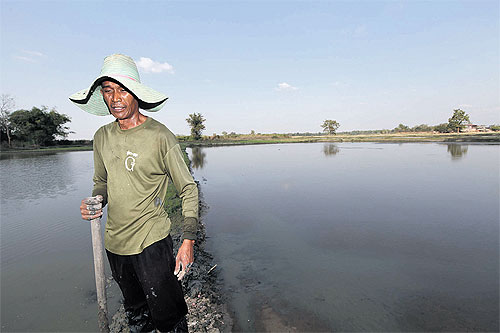
Farmer Winai Taweekantai makes an earth dyke before pumping water out of his rice field in Bang Rakam district, which isrecovering from the deluge.

The Bang Rakam Model promoted by the PM for flood relief and control has its good points, say Bang Rakam residents, but it needs some adjustments.

The Bang Rakam model

Early in the flood season last August, the new prime minister Yingluck Shinawatra visited Pitsanulok's Bang Rakam district and was impressed with how the people in the inundated areas there were coping.

Thus, was born the "Bang Rakam Model" in which local communities would set up one-stop service centres for flood victims. Where possible, water diversion systems would be set up similar to the one between the Yom and Nan rivers – seen as a long-term solution to flooding in Phitsanulok.

Wiboon Tangkasemwiboon, former chairman of the Bang Rakam Tambon Administration Organisation, is a key figure in implementing the plan in the area. 

He says it is only a rough framework and local residents and stakeholders are the ones who must help shape the scheme.

"Bang Rakam residents can live with the flood, as it brings nutrients and aquatic animals to our community every year. Our challenge, however, is how to deal with non-seasonal floods which hit us during the rice-harvesting period," he said.

Mr Wiboon commented that the current Bang Rakam model focused too much on flood-relief operations, while the locals think it should have a greater focus on water management.

According to Mr Wiboon, the model should include measures on how to delay floodwater from arriving in the district before the harvesting period in September. 

The opening of sluice gates in the district's waterways should be adjusted to better drain water out of the district in the wet season and to keep water in the area for longer during the dry season.

Community development experts, however, have warned that the proposed water diversion project on the Yom and Nan rivers under the Bang Rakam Model could lead to conflicts between the upstream and downstream communities.

Adapted from a story in today's Bangkok Post by Apinya Wipatayotin.

cope – to deal successfully with a difficult situation รับมือกับ
community – the people living in one particular area ชุมชน

victim – someone who has been affected by a bad situation, such as a disaster, illness or an accident เหยื่อผู้เคราะห์ร้าย
diversion – causing something to change direction การเบนเส้นทางเดินน้ำ
similar – like somebody/something but not exactly the same คล้ายกัน

solution – a way of solving a problem or dealing with a difficult situation วิธีแก้ปัญหา
key – very important ที่สำคัญ

figure – someone who is important in some way บุคคลสำคัญ
implement – to make something such as an idea, plan, system or law start to work and be used นำแผนหรือนโยบายมาปฏิบัติ, นำมาใช้

rough – not exact; not including all details คร่าวๆ
framework – a system of rules, ideas or beliefs that is used to plan or decide something ขอบข่ายงาน, โครงร่าง

local – in or related to the area that you live, or to the particular area that you are talking about ท้องถิ่น
residents – people who live in a particular area ประชาชนที่อาศัยในท้องที่

stakeholder – someone who has an interest in the success of a plan, system, or organization, for example a worker in a company or the parent of a child at a school ผู้ถือผลประโยชน์ร่วม

scheme – a plan that is developed by a government or large organisation in order to provide a particular service for people แผนการ โครงการ

nutrient – a substance that is needed to keep a living thing alive and to help it to grow ธาตุอาหาร, สารอาหาร
aquatic – growing or living in or near water เกี่ยวกับน้ำ

challenge – something that needs a lot of skill, energy, and determination to deal with or achieve สิ่งที่ท้าทาย, การท้าทาย

harvest – the activity of collecting a crop, in this case a rice crop การเก็บเกี่ยวผลผลิต
current – of the present time ปัจจุบัน

focus – to give attention, effort, etc. to one particular subject, situation or person rather than another เพ่งความสนใจ

relief – help; assistance การช่วยให้พ้นภัย
operation – an activity which is planned to achieve something การดำเนินการ
measure – an action taken to solve a particular problem มาตรการ

delay – to make something happen at a later time หน่วง, ซื้อเวลา, ยืดเวลา
sluice gate – a gate that can be opened or closed to control the flow water along a passage ประตูน้ำปิดเปิดบังคับการไหลของน้ำในคลอง

adjust – to change something slightly, especially to make it more correct, effective, or suitable ปรับ
drain – to cause water or fluid to flow out ระบายออก

expert – someone who has a particular skill or who knows a lot about a particular subject ผู้เชี่ยวชาญ
proposed – suggested as an idea for a group to consider ถูกเสนอ

conflict – an angry disagreement between people or groups ความขัดแย้ง
upstream –along a river, in the opposite direction to which the river is flowing ต้นน้ำ

downstream – in the direction that a river or stream is flowing ตามกระแสน้ำ

Remaining water no threat to Bangkok

There are still about 8 billion cubic metres of floodwater to the north of Bangkok, but the city itself is safe from any fresh inundation, water management adviser to the Flood Relief Operations Command (Froc) Anond Snidvongs said on Wednesday.

He would consult with the strategic committee on a national water resources management system on measures to manage the leftover water.

Mr Anond said there were around 8,000 million cu/m of northern runoff still in Central provinces, to the north.

About half of this must be stored for farm use. The rest has already flowed into local waterways, but the overflow would hardly bother the capital.

In Bangkok and nearby provinces, the flooded area has shrunk from 2.7 million rai on Nov 12 to a million rai - and most of this area was in paddy fields and grassy areas in the western districts of Bangkok.

He said there was only a small volume of floodwater still on the eastern side of Bangkok, because the water had been drained out faster than expected through the Bang Pakong River.

Mr Anond added that in the future the strategic committee on a national water resources management system would have to lay out the new structure for water management facilities to the wast and east of Bangkok.

He anticipated that after all flooded areas were dry, many people would try to prevent future flooding of their own places by building walls or elevating their land surface.

The strategic committee would soon set regulations to ensure all floodwalls and land elevating activities meet a standard.

The criteria would be in line with the Environment Act, while the committee would monitor the erection of flood walls and the land elevationactivities through satellite photos, said Mr Anond.

BMA: Floodwater receding

The Bangkok Metropolitan Administration (BMA) on Wednesday reported that the level of the flood at Bang Sai had dropped by 11 centimetres overnight to 2.29 metres above sea level.

On the Phra Nakhon side of the capital, the water level in lower Hok Wa was down by 5 cm, down by 8 cm at Don Muang and 4 cm at Mahasawat canal.

While the Thon Buri and Bang Prom canals were overflowing by 4cm Bang Waek was right at the brim and Bang Chuek remained stable.

Saen Saeb had fallen by 3-5 cm, Prawet 1 cm, Lad Phrao 2-6 cm, Praem Prachagorn 2 cm, Baen Kaen1-2 cm, and northern Thon Buri 4-5cm, the BMA reported.

Froc: Remaining floodwater no threat to Bangkok

There are still about eight billion cubic metres of floodwater to the north of Bangkok, but the city itself is safe from any fresh inundation, water management adviser to the Flood Relief Operations Command (Froc) Anond Snidvongs said Wednesday.

He would consult with the strategic committee on a national water resources management system on measures to manage the leftover water.

Mr Anond said there were around eight billion cu m of northern runoff still in the Central provinces, to the north.

About half of this must be stored for farm use. The rest has already flowed into local waterways, but the overflow would hardly bother the capital.

In Bangkok and nearby provinces, the flooded area has shrunk from 2.7 million rai on Nov 12 to a million rai - and most of this area was in paddy fields and grassy areas in the western districts of Bangkok.

He said there was only a small volume of floodwater still on the eastern side of Bangkok, because the water had been drained out faster than expected through the Bang Pakong River.

Mr Anond added that in the future the strategic committee on a national water resources management system would have to lay out the new structure for water management facilities to the west and east of Bangkok.

He anticipated that after all flooded areas were dry, many people would try to prevent future flooding of their own places by building walls or elevating their land surface.

The strategic committee would soon set regulations to ensure all floodwalls and land elevating activities meet a standard.

The criteria would be in line with the Environment Act, while the committee would monitor the erection of flood walls and the land elevation activities through satellite photos, said Mr Anond.

The Bangkok Metropolitan Administration (BMA) today reported that the level of the flood at Bang Sai had dropped by 11 centimetres overnight to 2.29 metres above sea level.

On the Phra Nakhon side of the capital, the water level in lower Hok Wa was down by 5cm, down by 8cm at Don Muang and 4cm at Mahasawat canal.

While the Thon Buri and Bang Prom canals were overflowing by 4cm Bang Waek was right at the brim and Bang Chuek remained stable.

Saen Saeb had fallen by 3-5cm, Prawet 1cm, Lad Phrao 2-6cm, Praem Prachagorn 2cm, Baen Kaen 1-2 cm, and northern Thon Buri 4-5cm, the BMA reported.

Flood-hit areas escape disease outbreaks

No major disease outbreaks related to the flood crisis have been found, though risks still remain for residents returning to their homes, say health authorities.

Months of flooding had not caused harmful waterborne outbreaks and the incidence of post-flood diseases was not as high as anticipated, said a joint statement released by the Ministry of Public Health, the World Health Organisation (WHO) and Thailand MOPH-US CDC Collaboration.

Disease surveillance data showed most common illnesses in affected populations were minor such as athletes foot, upper respiratory tract infection, conjunctivitis and food poisoning.

These illnesses were mostly found in shelters and were quickly managed. The overall rates for these health conditions were not much different from seasonal incidents.

Most deaths associated with the flood were due to accidents, especially drowning and electrocution. The Flood Relief Operations Command reported a total of 675 deaths, three people missing and more than 4.7 million people affected.

International communities were concerned over the post-flood outbreaks while local health experts also warned that a leptospirosis outbreak could also re-emerge through the lack of good sanitation and garbage management.

People were also advised to be aware of the risk of fungal-related and water-borne diseases when returning to their houses after the floodwater has receded, as the risk period had not yet ended.

Public Health Ministry permanent secretary Paijit Warachit said much support from the WHO and Thailand MOPH-US CDC Collaboration and many other countries in terms of providing medical equipment, 

supplies and technical cooperation enabled the country to carry out disease surveillance and run control systems effectively during the emergency situation.

Activities included sending hundreds of mobile medical units to provide health services in temporary shelters and flood-affected communities as well as sending rapid response teams to monitor the health situation.

They also investigated reported outbreaks and improved sanitation and food safety at shelters and communities.

DSI expands probe of relief supply bags

The Department of Special Investigation is expanding the scope of its investigation into alleged irregularities surrounding the recent procurement of flood relief supplies.

Tharit: ‘No intention of implicating last govt’ 
The investigators are also looking into previous purchases of flood relief bags over the past two years, said DSI chief Tharit Pengdit yesterday.

He said the DSI had no intention of implicating the previous government in the corruption probe.

The fresh inquiries would get under way simply because two companies had won the bids to flood relief bags for a long time, Mr Tharit said.

The inquiry also would have to look into what had happened in the past to make the investigation more thorough and complete, said Mr Tharit.

Mr Tharit also said that he could not confirm at this stage media reports that 11 officials of the Department of Disaster Prevention and Mitigation (DDPM) were really involved in any irregularities in the recent procurement of flood relief bags, despite earlier reports which said they were. He said he would rather wait until solid evidence came to light.

Mr Tharit said investigators have initially linked a group of people to the alleged procurement irregularities.

Earlier, a DSI source said investigators had found that 11 DDPM officials including a deputy director-general were likely to be involved in the irregularities.

The findings were established by two investigation teams led by Thanin Prempree, deputy chief of the Office of Special Criminal Cases 2, and Pol Col Narat Sawettanant, a deputy DSI chief.

The teams concluded from witness testimony and evidence that the 11 department officials might have either violated Section 157 of the Criminal Code by abusing their authority or broken the bidding collusion prohibition law.