Showing posts with label Bank of Thailand. Show all posts

Tuesday, 3 January 2012

Flooding brings grief to more southern provinces Tens of thousands of homes are inundated

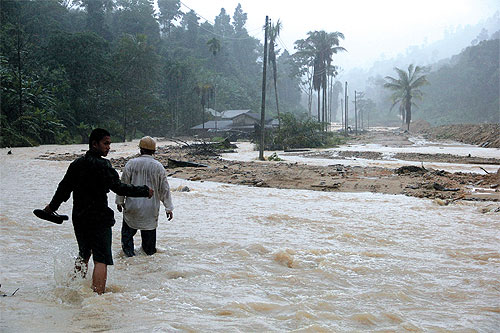
People wade through run-off sweeping through Ban Phian village of tambon Thepharat in Sichon district of Nakhon Si Thammarat province yesterday.

As floodwater started receding in the four southernmost provinces, the flooding expanded to four other provinces yesterday.

Residents in some areas were put on high alert for mudslides triggered by torrential rains which have pelted the South during the past three days.

The floods have inundated tens of thousands of homes, forcing residents to seek shelter elsewhere and causing significant economic damage.

Nakhon Si Thammarat, Chumphon, Trang and Krabi were the latest four provinces to be hit by flash flooding and mountain runoff triggered by heavy downpours.

Thousands of residents in mudslide-prone areas, including Nakhon Si Thammarat's Nop Phi Tham district, have been evacuated to safe ground to prevent a repeat of last year's tragedy.

Mudslides hit the district in March 2011, killing several people.

But flooding in the southernmost provinces of Songkhla, Yala, Pattani, Narathiwat has eased and many affected areas have dried out. Officials said all would return to normal by today as long as the rains cease.

The continuing rain yesterday caused flash floods in three districts of Nakhon Si Thammarat, including Nop Phi Tham, Sichon, and Lan Saka.

Floodwaters cut off at least six bridges and roads in Nop Phi Tham district, leaving several villages isolated from the outside world, the Disaster Prevention and Mitigation Department reported yesterday.

Nop Phi Tham district chief Preecha Koomwong said tambon Krung Ching was the hardest hit area as floodwaters washed away temporary bridges built to replace the ones destroyed by last year's flash floods.

Mr Preecha said he feared there would be more flash floods and landslides if the rain continues this week.

In Sichon district, almost 200 families living in landslide-prone areas have been moved to evacuation centres after between 20 and 40cm of rain fell during the prior 24 hours.

Nakhon Si Thammarat governor Viroj Jiwarangsan said officials had been sent to disaster-hit areas to repair roads and bridges to enable the delivery of relief supplies.

Runoff from Banthad mountain also inundated some districts of Surat Thani, Trang and Phattalung provinces.

In 11 districts of Phatthalung, about 30,000 families' homes were flooded in tambon Kuan Saothong, where water reached two metres on Sunday night.

The waters began to recede yesterday afternoon.

Meanwhile, authorities have managed to contact the eight hikers who went missing during an excursion to Khao Lon mountain over the weekend. All of them were safe.

They said communication signals was down because of bad weather.

In Chumphon, Lang Suan Hospital in Lang Suan district was inundated yesterday afternoon. The water level rose rapidly, prompting medical staff to quickly move patients and medical equipment to higher floors.

In Thung Tako district, flash floods inundated a 200-metre section of Highway 41 linking Chumphon and Surat Thani yesterday, making it impassible to motorists, who had to use a bypass road instead.

The incident caused traffic congestion along the southern road which was already crowded with motorists returning home from the New Year holidays.

The Chum Phon-Lang Suan and Lang Suan-La Mae roads were also closed due to flooding.

Science and Technology Minister Plodprasop Suraswadi yesterday inspected Thung Wua Lan beach in Pathiu district which was damaged by high waves recently.

Mr Plodprasop said the ministry was planning to install a wave detection device to warn residents of high waves before they reach the shoreline.

He also ordered local authorities to take legal action against resort operators who have encroached on public beaches.

In other news, flooding in the southernmost provinces improved yesterday as the water quickly drained out to the sea.

Hat Yai's business district was spared from flooding, which affected only three communities in Hat Yai municipality.

Songkhla governor Grisada Boonrach said the Royal Irrigation Department has sped up the draining of water out of U-tapao canal.

He said the situation would return to normal shortly if there is no more rain, although authorities plan to keep a close watch for possible flooding today. On New Year's Eve, flash floods inundated the homes of more than 20,000 people in 12 districts of Songkhla, he said.

Public Health Minister Wittaya Buranasiri yesterday said three hospitals in Songkhla were slightly damaged by the floods. Three critical patients in flood-hit Sadao district were transferred to Hat Yai Hospital on Sunday.

In Pattani, floods receded in eight districts which were hit by flash floods over the weekend.

However, residents were told to stay on alert for more flooding, especially those near Pattani and Sai Buri rivers.

Residents in six coastal districts were also warned of high waves and turbulent seas today and tomorrow.

In Narathiwat, floodwater started receding in some parts of 10 affected districts.

Villagers living in landslide-prone areas were told to prepare for evacuation after five homes at the foot of mountains in Muang and Rueso were swept away by strong mountain runoff on Sunday, while 20 others were slightly damaged.

In Yala, floodwater receded in Muang, Raman, Bannang Sata, Krong Pinang, and Yaha districts. The water level of the Pattani River, which breached its banks and inundated a number of communities on Sunday, was also receding yesterday.

Tuesday, 22 November 2011

A little less sweet and a whole lot tougher

All leaders are tested. As Thailand's first woman prime minister, Yingluck Shinawatra's first trial is the flood of 2011.

Prime Minister Yingluck Shinawatra attends the Asean Summit in Bali on November 18.

A natural disaster is an immense challenge for any leader. For Thailand, it involves expediting the bureaucracy to get timely relief to the people, moving and managing relief funds, planning and executing a large-scale recovery effort and balancing national and provincial-level politics.

The coordinating of logistics alone, in order to manage the crisis, is overwhelming.

The flood has brought our government's weaknesses to light. It has shown us the coordination loopholes that exist between different government departments that hamper their ability to work together. It has revealed the ugly side of some of our politicians.

It has shown us that we do not have adequate capability to rapidly respond to large-scale disaster. We didn't have a good plan on the books. And even if we did, our execution has been borderline poor at best.

And what did our prime minister do? She took a promising first step, by putting all her other prime ministerial duties on hold and placing flood relief efforts at the top of her priority list.

She solicited advisers for relief plans and ideas. She inspected the damage and reassured people that their government was working hard to relieve the situation.

She has talked with flood victims and actively monitored the crisis. She has put other work on hold and made relief for the Thai people her first priority.

In dealing with the flood, our prime minister has been forced to work with many handicaps.

First, she doesn't have the necessary leadership experience to handle the flood because her resume{aac} is almost exclusively in business.

How often does the CEO of a company plan and execute disaster relief? Most would certainly prepare for the potential impact of a natural disaster on their business, but very few would care beyond that.

Second, our lady prime minister's leadership style might not be well-suited to the situation. A flood is best managed with military-style leadership and centralised decision-making, with decentralised execution.

In a situation with widespread disarray of the infrastructure, precision guidance is vital for reorganization.

The prime minister's matronly style and her aristocratic charm hardly fit the bill. It's nice that she is handing out relief bags one at a time in perfect hair and make-up.

It shows that she cares and it makes great evening news. But wouldn't a prime minister with executive powers be better off figuring out how to hand out thousands of bags instead?

If a natural disaster is like a storm at sea, then the prime minister is like a ship's captain who needs to grab hold of the wheel and steer. A captain doesn't get on deck and start emptying out one bucket of water at a time; that's the job of the deck hands.

Third, our prime minister has little education or experience in emergency management. The last time Thailand endured this level of flooding was how many years ago?

And Yingluck has been in politics for how long? The math adds up to about zero. Our premier has very capable and experienced advisers and experts. But when experts and advisers disagree with one another, will she be able to make the right decision?

Now that the water in some areas has receded, the blame game is in full bloom. Most often, it's the person at the top who becomes society's No. 1 accused. But it's hardly fair to hold the prime minister responsible for every aspect of the flood relief mismanagement.

In adversity, people will do whatever they perceive as necessary to survive and to secure their livelihood. Sometimes this involved theft, coercion, and even acts of violence.

Our prime minister is not responsible for the immoral conduct of every man and woman affected by the flood that evil is our own making.

However, our premier is responsible for the execution of the relief system everything from the distribution of relief bags, movement of goods and supply to flood-hit areas, controlling the price of food and supplies, restoring sanitation and reopening roads and railways. The test is not over, and there is still work for her to do.

We know that our prime minister excels at meetings and engagements, shaking hands with dignitaries and charming everyone with her sincerity. All of us were smitten by her demeanour, her glamour and her charisma.

And if it were not for the flood, she would be at these meetings and engagements _ getting them all smitten by deadly kindness. Instead, fate has given her an opportunity to rise up against adversity and truly make a difference for her people.

Perhaps it's time we saw the gallant side of our lovely prime minister. After all, she is a mother, the disciplinarian of the household.

This disaster is a chance for her to add toughness to her elegant rapport. We have been ripped to shreds by this disaster. We are tired of the same old song of promise and reassurance.

What we desperately need is strength. We need someone upfront who will unite us. Someone who will be the hope of better days ahead.

Wednesday, 16 November 2011

12 of Thailand’s largest companies kick off post-flood rehab project

Twelve leading Thai corporations on Tuesday jointly launched a special fundraising project for the country’s post-flood relief and rehabilitation.


Named "The Power of Thai", the project was set up by 12 of Thailand’s leading private companies, including Thai Beverage (ThaiBev), Central Group of Companies, True Corporation, Bangkok Bank, GMM Grammy, Thai Union Frozen Products, BTS Group Holdings, Mitr Phol Group, Major Cineplex Group, Muang Thai Life Assurance, Advanced Info Service (AIS) and ICC International.

The first fundraising event of the Power of Thai project is to sell one million wristbands in next two weeks. The group expects to earn Bt100 million from sales and plans to spend the money to relieve flood victims through various activities.

As several companies earlier held their own flood rehabilitation and relief activities, initiator Thapana Sirivadhanabhakdi, ThaiBev president and CEO, believes the new group can help boost and strengthen efficient cooperation and management in the private sector, and invites other companies to join this project.

Initially, each company contributed money to related processes, the ThaiBev president said. Money earned from the wristband fundraising event will be spent on rehabilitation, particularly for school repairs, as the floods damaged many schools.

According to a survey, at least 1,900 schools, including buildings and equipment, were destroyed in flood-hit provinces, according to True president and CEO Supachai Chearavanont. 

He explained that the group is focusing on school repairs and education-related rehabilitation as education is crucial and the schools are like community centers.

Regarding post-flood economic rehabilitation, Mr Supachai said that he agrees to the government speeding up investment in a project related to a mega-irrigation system and its management.

Not only would it help boost the economy, employment and money circulation, the irrigation project will also build investors’ confidence to invest in Thailand, the True president and CEO added.

Tuesday, 15 November 2011

Soldiering on through the flood Members of the Thai army are on a different kind of front line, serving the public in this hour of need

Despite not having slept for two days, Prinya Vijachai, a second lieutenant with the Thai Army 11 Regiment, 2 Battalion, King's Guard, seems in good spirits attending to the needs of flood victims in Bang Khen district.

He is one of hundreds of soldiers who work round the clock to bring relief assistance to all the residents. The 35-year-old pays special attention to the needs of women, children, the sick and the elderly. Prinya is also a walking call centre, tasked to connect distressed callers with the right source that would best remedy their grievance.

The burly Udon Thani native brushes off the need for sleep by saying that it is his national duty to serve the general public in their time of great need. 

Wearing sunglasses to cover his bloodshot eyes, he admitted that his heart went out to the thousands of families who had been affected by the deluge. His only regret is not being able to help everyone.

Soldiers came in from day one of the deluge, setting up relief call centers, shelters, transport and other flood relief measures," said Prinya in between taking calls from distressed victims. 

"I try to spend as much as time with the caller to determine just how we can help them. We also do get our share of prank calls along the way, which doesn't upset me because I realise everyone is under a lot of stress.

"Thai soldiers have united to address the needs of the people who have been affected by this catastrophic inundation. A life of soldier is all about sacrifice, so most of us have gotten used to a few hours sleep.

Compared to the numerous families that sleep in knee to waist deep waters, we are very lucky that our barracks are dry.

My sleeping pattern has been affected because the only time I get to do logistics involving donations and other relief work is when I get back to my headquarters. 

Part of my duty is to coordinate between agencies and groups interested in taking part in the flood relief efforts, which is currently focused on gathering drinking water and bamboo rafts and boats. However, we are open to all sorts of assistance."

Prinya has a team of 60 soldiers that take turns manning the Bang Khen roundabout flood relief coordination center (08-5675- 1427) daily. On the day Life caught up with him, Prinya had just taken a paralytic to hospital and was on an army truck delivering donated bamboo rafts and drinking water to the flood relief coordinating centre. 

He explained that the floating contraptions had to be distributed sparingly because there were not enough to go around. Recipients should reside in homes flooded above waist level.

As our conveyance navigated its way through a sea of murky waters, the large waves it generated landed on people who were wading through it. 

Both Prinya and his subordinate, who was in the driving seat, dutifully apologized to the pedestrians by offering them a wai.

Evacuation orders from the Bangkok Metropolitan Administration (BMA) for communities in the Bang Khen and Laksi districts unfortunately fell on deaf ears, said Prinya.

"Less than 20% of the residents [in these areas] heeded to the call to leave. Many that left originally came from other parts of the country, the ones that stayed either have a home or have resided in these areas all their lives. 

Their concern for their material belongings and pets is often the primary reason they decide to stay.

"Just recently we were called to accompany a pregnant women from a house in Phahon Yothin soi 48, who despite being in labour refused to go to hospital for fear that her home would be robbed. She would only leave when we guaranteed someone would watch her place."

Just as we arrived at the flood relief center, Prinya began supervising soldiers unloading rafts and water bottles under a tarpaulin. In less than an hour, he received yet another distress call  this time from a volunteer informing him of Thongbai Thamthong, 93, who was in immediate need of medical attention for her heart condition. 

In minutes we were on an army truck heading towards Phahon Yothin soi 49/2, a paramedic and wooden boat in tow. Prinya and his men trudged through thigh-level floodwater to reach the awaiting patient.

Pencil-thin Thongbai and her husband sat precariously on their staircase as waters had risen well above a meter in their living room. On being told that she was to be taken to the hospital, Thongbai threw a tantrum and refused to leave her home saying that thieves would loot it if left unattended. 

It took 30 minutes to convince the nonagenarian to get on the boat that would take her to the army vehicle parked 200 meters from her home.

Thongbai became cheerful on the way to the hospital: "My heart has been causing me trouble, but nothing serious," mused the former school teacher. "

I don't want to be a nuisance to the soldiers who have been of great help to our community. They are sometimes slow in getting us flood relief, but I understand this is because they are busy with many tasks.

"The other day one of my neighbors called one of them to fix a faulty electric wire. He managed to do a good job. But when she wanted to show her appreciation by offering him a small reward, he refused to accept it. 

I have found them to be patient and kind to us. I am relieved to know that they are nearby and can be called on for every need."

Thongbai rolled her eyes in anxious anticipation when asked to comment about the rising waters in her home.

She said in all her years she had never experienced such severe flooding. "If you ask me, the deluge is here to help us purge the poison that has been caused due to disunity among Thais. I hope we can all learn a lesson from this."

As we sat chatting, a number of pedestrians, who bravely had ventured out to purchase groceries, requested to be picked up and sent to their home a few sois away. 

With an acute shortage of public transport, army vehicles often pick up residents traveling in the same direction.

On the way to sending Thongbai to hospital, Prinya's phone began to ring of the hook once again, this time requesting assistance to pick a lady in her early 50s with thyroid complications from Amarin Nives 1 housing estate. As the patient's home was on our way, we picked her up on a stretcher from a housing estate chest deep in water.

The army truck left us at the Bang Khen roundabout on its way to the hospital because Prinya had to supervise a team of soldiers to carry donated clothes to an evacuation shelter at Phranakhon Rajabhat University. 

During the half hour wait, we managed to have lunch consisting sticky rice and dried green curry rolled up neatly in plastic bags. It was 3pm by now.

Prinya ate his meal while answering his phone under a makeshift tent, which served as a flood relief center with a couple of chairs and fordable table. 

A few meters away a young soldier was attending to a deaf young woman's request to enter her flooded home to retrieve her belongings. He seemed attentive and spoke kindly, offering a bag of lunch and drinking water to her as they communicated through written language.

On our way to Rajabhat University, Prinya said that his biggest worry was for people in waist-deep waters and hoped that they would request to be evacuated soon. 

Since the floods converged a month ago, over 400 residents had moved to Chon Buri's evacuation center. He said a concerted effort should be made to find safe areas that are not in sectors susceptible to floods.

Chaeng Watthana Road, where the Phranakhon Rajabhat shelter is housed, resembled an expanse of klong water. Needless to say, the educational institution is also under flooded water. 

The housing for the evacuees is on elevated ground. After the team effort taken to distribute used clothes to them, we concluded our mission for the day as the sun began to set by accompanying soldiers to survey the communities that live in the inner sois of Phahon Yothin and surrounding areas.

By and large residents in the communities put on a smile for the visitors. Chai, a 29-year-old shop owner, said he has a renewed sense of respect for the soldiers since the waters destroyed his business and they stepped in to assist with bringing some sense of normalcy in their daily lives.

"Since the floods arrived, the soldiers have become a part of our community. They might not always be efficient but they are polite to us. I believe that they are genuinely concerned about our well being. 

Through the kindness they have showed us, I have a more positive opinion of them. When we offer them money for a kind deed, they refuse. 

They say if we want to show our gratitude towards them to post an encouraging message on Facebook."

Monday, 14 November 2011

Should Thailand Give Up on Bangkok and Move its Capital?

The floodwaters soaking Bangkok are only likely to continue, and in 50 years much of the city may be permanently underwater.


The flooding in Bangkok shows little sign of getting better, and its impact on Thailand's economy and the global supply chain of many computer and automotive components has yet to be fully tallied. 

Japanese companies in particular have made enormous investments in Thailand and have been particularly hard hit by the flooding, but all computer disk drive makers and many car manufacturers have been affected.

People are stranded throughout Bangkok, the government's messages are still confusing and hard to understand, and the divisions in Thai political society have prevented the type of unity in the political system that should be necessary at such a time of crisis. 

In addition, diseases carried by the fetid water are beginning to be a problem in Bangkok and the outlying suburbs. Many foreign investors will now rethink their decisions to place so much of their supply chain in Thailand.

But even more worrying, these floods, which are the worst in Thailand in fifty years, could be a harbinger of the future.

In an excellent story by Agence France Presse , reporters in Bangkok examine why the Thai capital is likely, in years to come, to face similar if not worse floods. 

Such floods could repeatedly devastate Thailand's manufacturing base and threaten the millions of people in the capital, which dominates Thailand as the country's political, cultural, and economic epicenter. 

Urbanization in the city's outlying areas has reduced regions of vegetation that absorbed water in the past; overbuilding in the city core has done the same. 

The capital, built on swamp, is still sinking every year, and with global temperatures rising and weather patterns changing, 

Thailand is likely to face a longer, more intense rainy season for years to come -- which would in turn make the city harder to drain and would more consistently overflow the Chao Praya River. 

The OECD has classified Thailand's capital as one of the ten most endangered cities in the world, according to the AFP report. "In 50 years most of Bangkok will be below sea level," Anond Snidvongs, an expert on water management, told AFP.

One solution that some Thai environmental experts have begun to suggest: Move the whole capital to land that is higher, more secure from flooding, and easier to protect with dikes. 

Some think that, over time, this is the only solution and that  even with continued groundwater pumping, better dikes, and more effective flood management concentrated in one government agency  Bangkok is still too insecure to survive global climate change. 

And the Thais have moved their capital before  from the city of Ayuthaya to Bangkok. But that was in 1782.

Sunday, 13 November 2011

Vocational training

The secretary-general of the non-formal education promotion office said yesterday the Education Ministry had allocated Bt490 million to provide vocational training for people affected by the flooding.

Prasert Bunruang also revealed a plan to propose Bt2.8 billion as an annual budget to provide vocational training at communities and tambons in some 30 provinces hit by flood disaster. 

He said people who do the training would also be given Bt5,000 seed money to buy materials or tools. 

After the flood subsides, the office will also dispatch 77 teams of volunteers with 77 water pumps in 77 vans to help clean flood-damaged homes, schools or temples free-of-charge, he said.

Thailand face a daunting task in cauldron


Thailand's SEA Games aspirations will be put to a stiff test when they face a decisive match against hosts Indonesia today.

After making a dismal start to their campaign with a 2-1 loss to defending champions Malaysia, the Thais, who won the title eight consecutive times, bounced back by recording a 4-0 win against lowly Cambodia on Friday.

The victory was a flattering outcome, given that they were made to toil for long periods before scoring three goals in the space of 10 minutes late in the second half.

Such an unconvincing performance, which came after a lethargic display in the Malaysia fixture, in which they were fortunate not to have lost by a bigger margin, hardly inspired optimism ahead of the meeting with unbeaten Indonesia.

With the Thais currently languishing in fourth place with three points from two matches, only a win against the hosts, who top the standings with a perfect record, would do for them if they are to avoid an early exit for the second consecutive time. 

A defeat is likely to spell an end to their campaign even before the final group game against Singapore.

Thailand face the daunting prospect of playing in a hostile atmosphere at the Bung Karno Stadium, which has a capacity of nearly 100,000 and no doubt will be packed to its rafters by raucous home support. 

Mental strength, therefore, will be the key. Kasem Jariyawatwong, the team manager, is convinced that his players are well equipped to handle such a pressure situation.

"We're not out yet. We have two matches left to fight for our survival. Whether we could do it or not, we have to give our utmost. 

I am trying to keep the team motivated. We were down when we saw what people thought about our performance on the Internet. We'll keep fighting.

"It's normal that form would fluctuate sometimes. There's nothing to be gained by making rash judgements. The players are still young and they need the support of the fans.

"We're improving each game. Each player seems to have found his rhythm. There's no doubt that the game against Indonesia will be tough. The stadium will be turned into a cauldron by the home fans.

"I think the experience of playing in the Thailand Premier League would stand the players in good stead for this kind of game. We have no choice but to win," said Kasem.

Theerathon Bunmathan will sit out the World Cup qualifier at home to Australia on Tuesday, serving his suspension for a red card in the 3-0 away loss to Saudi Arabia. As a result, Kasem said, the left back would join the team earlier than scheduled. 

He reckoned that a decision on whether to field the player against the Indonesians needed to be made in the best interest of his health.

"Theerathon will arrive here at noon tomorrow. We have to check on his condition. It would be too selfish if we risk the health of a player for the victory of the team. 

I already got confirmation that his suspension in the WC qualifiers would not apply in the SEA Games."

Thai princess: King temporarily lost consciousness

In this Dec. 5, 2010 file photo released by the Thai Royal Household, Thai King Bhumibol Adulyadej delivers his annual birthday speech as part of his 83rd birthday celebration at the Amarindhara throne hall inside the Grand Palace in Bangkok, Thailand. The daughter of Thailand's 83-year-old king has revealed that her father recently had a health problem that caused him to temporarily lose consciousness. Princess Chulabhorn said Friday Nov. 11, 2011 during a visit to flood victims north of Bangkok that King Bhumibol Adulyadej went into shock and lost consciousness after suffering abdominal bleeding and a sharp drop in his blood pressur

Thailand's ailing king — the world's longest-reigning monarch — recently suffered a health problem that caused him to temporarily lose consciousness, his daughter revealed, linking the incident to stress over the country's flood crisis.

News that the health of 83-year-old King Bhumibol Adulyadej took what Princess Chulabhorn described as a brief turn for the worse comes as floods have inundated much of Thailand, including parts of Bangkok and its suburbs. 

More than 500 people have died, damage is estimated at several billion dollars and central Bangkok remains threatened.

Chulabhorn, the king's youngest daughter, said Friday during a visit to flood victims in Nonthaburi province north of Bangkok that King Bhumibol had gone into shock and lost consciousness after suffering abdominal bleeding and a sharp drop in his blood pressure. 

She said that about 800 cc of blood had been found in his bowel movements.

Chulabhorn said the king returned to normal health after being treated at the hospital where he has been staying for more than two years, according to the official royal news broadcast Friday night. 

The king, who took the throne in 1946, was originally hospitalized on Sept. 19, 2009, with a lung inflammation. Official statements said he remained at the hospital for physical therapy and nourishment to recover his strength.

In May this year, he had an operation to relieve a condition that made him walk unsteadily. A statement issued at the time said the spinal tap procedure was to relieve a condition common in the elderly — an excessive level of cerebration fluid resulting in pressure on the brain.

Chulabhorn said Friday that after the May operation, the king "seemed to be at ease" until the flood crisis. The king has been shown from time to time on television speaking — sometimes with difficulty — at royal functions held at the hospital.

Chulabhorn said doctors told her the recent bleeding could have been caused by concern over the flooding.

"So I asked the nurse what he had been doing in the past few days," Chulabhorn said. "It turned out that he had been watching news about the flood. 

This indicates that His Majesty the King loves his people as his own children. He is very concerned and he usually doesn't speak much, but (his concern) is seen in his physical condition."

She did not specify when the health problem took place, but her comments indicated it was more than a week ago. 

She had previously spoken about it on Nov. 7, though not in such detail, and said Friday that it happened the same day she had been visiting flooding victims in Ayutthaya province, also near Bangkok. She visited a Buddhist temple there on Nov. 4.

The Royal Household Bureau, which is in charge of releasing news about the king, said Saturday that it could provide no further details on the king's health.

Bangkok's Siriraj Hospital, where the king is staying, said it could provide no information without the approval of the Royal Household Bureau.

It is potentially unlawful for private citizens to publicly comment on the king's health. In 2009, four people were arrested on suspicion of using the Internet to spread rumors about the king's health. 

Under the Computer Crime Act, spreading false information deemed harmful to national security is punishable by up to five years in prison and a fine of 100,000 baht ($3,260).

Open discussion of the monarchy is also constrained by strict lese majeste laws that make criticism of the monarchy punishable by up to 15 years in prison.

A doctor in neighboring Myanmar asked to comment on the king's symptoms said it would take more than psychological stress for someone to lose 800 cc of blood. 

Dr. Tun Kyaw, assistant surgeon at the government hospital in Yangon's North Okkala neighborhood, said there had to be other reasons, such as an existing affliction or side effect from medicine. 

Blood-thinning drugs can cause abnormal bleeding.

The doctor added that the blood the king lost "is a significant amount, especially for elderly people."

Dr. O.P. Sharma, an expert in geriatric medicine in India, said the king likely would have required an immediate blood transfusion, constant blood pressure monitoring and an endoscopy if more bleeding occurred. 

But he added that the prognosis for such episodes is often good and that it's difficult to predict whether the bleeding will occur again.

"They recover very well. He can recover pretty quickly," he said. "... It's a cause of concern, but I'm sure he'll recover."

The king traditionally has played a conciliating role in Thai society, and his decline in health has coincided with trouble in the Southeast Asian nation. 

A 2006 military coup ousting the then-prime minister ushered in a period of political instability marked by sometimes violent street protests.

His near-disappearance from the public scene has also raised concerns about what will happen after his passing. 

His son and heir-apparent, Crown Prince Vajiralongkorn, does not command the same respect and affection as the king.

Sensationalist news? We've just scratched the surface

As the flooding crisis worsens, one major Thai newspaper reminds us that cleanliness is next to circulation figures.


Being the biggest selling newspaper in any country comes with great responsibility. There is a commitment to providing readers with the truth, alongside choosing stories with the most benefit to the greatest number of people.


And in times of crisis, readers look to such mega-selling newspapers for advice and support.

Which is perhaps why Thai Rath, Thailand's biggest-selling newspaper, splashed a banner headline across its front page last Tuesday morning: 

WOMEN IN BANGKOK ARE WARNED: BEWARE OF THE THREAT OF ITCHY VAGINAS.

What the ... Itchy vaginas? Is that all? Isn't there anything else the women of Bangkok should be careful of?

What about the impending 15 billion cubic meters of water ominously crashing down upon them _ not to mention the men, too, and our beloved katoey?

Shouldn't women be concentrating on the deluge, or should they stick to, as you have just printed, examining their nether regions?

Put this in perspective, dear reader. Last Tuesday was a terrible day. The waters were closing in on areas such as Mor Chit and Ratchadaphisek and once again we Bangkok residents had the wet sword of Damocles hanging over us by a horsehair.

The city had stopped, with no schools and certainly no business. You were either underwater, under-educated or under threat of insolvency.

And in the middle of all this fear, nervousness and rage, Thai Rath breathlessly singled out women and their vaginas.

Before going any further I must jump in here and explain that Thai Rath isn't just memorable for its amazing circulation figures. 

It is also a newspaper not unlike The Sunday Sport in England, whose front page two weeks ago declared ''COLONEL GADHAFI WAS A WOMAN''.

(That wasn't the end of it. The following week its top story was about a Libyan shepherd who claims to have had a night of ''unbridled passion'' with the deceased dictator. Before he died, of course.)

For American readers, think of the Weekly World News and multiply its outrageous quotient by two _ difficult, when that publication regularly sports front page headlines such as ''ELVIS SPOTTED ON THE MOON''.

Here in Thailand we have Thai Rath, one of 10 or so daily papers, the circulation of which allegedly edges towards 800,000 copies a day.

Even if you don't read Thai you can easily spot it. It's the one with the front page pictures of grotesque one-eyed still-born babies, or a buffalo born with five legs, or, more commonly, a jackfruit in the shape of a naked woman.

And they love dead bodies. If you're in a car crash and it doesn't make page one of Thai Rath, well, it was a car crash not worth having in the first place.

They are particularly fond of accidents that behead the driver, though it must be said they have, of late, taken to pixillating the gory details for fear children may be psychologically affected.

Too late. At least three generations of Thais have grown up with such graphic shots on page one as they eat their morning kuayteo noodles. 

There's nothing quite like breakfast while poring over pictures of love triangle victims and drunk drivers who mistook the accelerator for the cigarette lighter. If you're gonna die before your time, do it in Thai Rath.

Last Tuesday was just another day in a big city threatening to be swallowed up by filthy chemical-infested water.

It was not a slow news day, either. Some big things happened.

Ratchadaphisek sprouted water from its drainage systems. Mor Chit bus station was underwater, as evidenced by my Thai friend who boarded a bus there at noon and managed to finally get out of Bangkok at 4pm.

Meanwhile, the government announced a ''high-level committee'' to be chaired by a ''veteran economist'' to map out a ''clever plan'' to get the country back on its feet.

Sprouting water ... crippling traffic jams ... an ingenious master plan ... and what did Thai Rath choose to highlight?

Maybe the newspaper was just harking back to the song that gripped the nation two months ago called Itchy Ear. You may remember my explaining that to you; the song title was a metaphor for another part of the body that required a scratch.

Or maybe it was just a case of a bunch of male journos sitting round the subs desk yearning for a bit of titillation in the middle of this deluge. I don't blame them. They are suffering from flood burn-out, as we all are.

I guess there are only so many ways one can report, day in, day out, water penetrating yet another district of Bangkok. 

To Thai Rath's credit, even the headless car crash victims and sexy jack fruits have been swept off the front page as they report the floods. It was time for some excitement, and last Tuesday we got it.

Thai Rath had its justification.

''There's a lot of dangerous bacteria in the polluted waters,'' Thai Rath screamed in its first few paragraphs.

''Women are urged to wear plastic underwear when venturing into the water. If that is not possible, women should properly bathe with soap after entering the water.'' I can see the sub-editors drooling over that.

Maybe I am being too harsh on Thai Rath. Maybe they were right. Women make up half the population, and as I said in the second paragraph of this column, newspapers should report on topics that affect the most people. 

Plus they were being constructive in their advice, albeit in a shady Pat pong-buy-one-porn-VCR-get-one-free manner, weren't they?

And besides  were all the other things that happened last Tuesday that I mentioned really more important? Sprouting water on Ratchadaphisek old news for anyone in Bang Bua Thong or Nava Nakorn Industrial Estate. Crippling traffic jams from Mor Chit  don't we have those every day?

And as for ''high-ranking committees'' being set up  can anybody tell me exactly what a ''high-level committee'' is? Are they manned by hi-so figures as opposed to lowly government officials with bad haircuts? 

Do they sit in high chairs? Is the water on the table Evian as opposed to Samut Prakan Bottled Water Enterprise?

And did you see the ''clever'' three-pronged approach this committee has proposed? First, address short-term problems. Second, clean up the city. Third, take preventative measures to ensure it doesn't happen again. That's high level thinking?

So in the end maybe Thai Rath wasn't wrong in its selection of the most important news of the day, despite being alone in running it on the front page.

But at the risk of being titillating myself, why stop at vaginas? What about male appendages _ surely they are at risk from bacteria, too? 

If Thai Rath doesn't want to be accused of getting off on its own headlines, why aren't they warning men about venturing into the water as well? Shouldn't we be wearing plastic pants and using soap, too?

No other Thai newspaper picked up this story and ran with it. Competitors were too busy reporting on the clever thoughts of that high-level committee, and certainly all of them ran the news of the water creeping up on Yingluck Shinawatra's own home a topic we can only hope Thai Rath avoided last Tuesday.

Flood situation improving: PM

Yingluck non-committal on inner Bangkok; Ban, Clinton to visit Bangkok on Wednesday


The flood situation in Bangkok is getting better with water receding in many places, Prime Minister Yingluck Shinawatra said yesterday, although she declined to say how far the flood water would stray into inner Bangkok and whether the Bangchan Industrial Estate will be safe.

Yingluck said the flood situation in Bangkok would be less severe than in the provinces, although there will be a high-tide period in mid-November. She said water drainage in the west of Bangkok needs further improvement.

Answering a reporter's question on how far she expected the water to reach inner Bangkok, the premier said, "It's difficult to say. I have to see the situation on November 13 today first as we are doing something to prevent the flood and we need to see to what extent it works."

If the water is drained to Saen Saeb Canal and the sluice Watergate can work well, everything would be all right, she said.

Earlier, in her weekly television and radio programmer, the prime minister said the "big bag" barriers - the temporary flood-prevention dykes made from 1-2 tonne sandbags - could delay water coming from the north of Bangkok, allowing time for better water management to the east of the capital.

Yingluck said she had ordered the Royal Irrigation Department to drain the water in the upper areas of the big-bag line to Rangsit Canal and then to the sea as soon as possible. 

Besides the order for the Interior Ministry to give help and compensation to residents of the areas affected by the use of big bags, which would slow down water drainage from their areas, the government had provided 70 large pumps, according to the Bangkok Metropolitan Administration's request, so that water can be drained faster.

The water drainage must be done quickly while the sea tide is not so high, she said.

In the west of Bangkok, Yingluck said, the repair of broken dykes at 14 points was expected to be finished by the weekend. If successful, then water trapped in Pathum Thani, Nonthaburi and the west of Bangkok should recede.

It is hard to make the west of Bangkok flood-free as the dyke system on this side is not as strong as in the east of Bangkok, she said. 

Moreover, the canal system was aligned in a vertical direction. The government had ordered canal dredging to expedite water drainage to the sea, Yingluck added.

The Transport Ministry is expediting recovery of road No 340, which was earlier flooded, to serve as a back-up road to the South in case Rama II Road becomes unusable, she said.

Regarding compensation, Yingluck said the Cabinet on Tuesday had approved Bt3.1 billion assistance for over 600,000 households in 30 districts of Bangkok. Each household would get Bt5,000 within 45 days.

Meanwhile, over 470,000 flood victims, or 90 per cent of the total, in 36 provinces have already received compensation. The Government Savings Bank would give the money to the remaining victims by Tuesday, she said.

Up to Bt30,000 assistance would be paid if a victim's house is fully damaged; up to Bt20,000 would be paid in case of partial house damage; up to Bt25,000 assistance in case of death and up to another Bt25,000 in case of death of the head of the family, she said.

Yingluck said the flood situation in the central region was improving, with many provinces having almost returned to normal, including Ayutthaya, Nakhon Sawan, Sing Buri and Ang Thong. 

Some provinces had organised "big cleaning day" campaigns to clean up their provinces and bring them back to normal.

Yingluck expressed gratitude for help from foreign countries such as Switzerland, the Netherlands and the United States and also thanked the MPs for the vote on the first reading of the 2012 Budget Bill. She promised the money would be used transparently and for the best benefit of the people.

On Wednesday, UN Secretary-General Ban Ki-moon and US Secretary of State Hillary Clinton will visit Thailand. They will visit flood-affected areas in Bangkok in separate missions before discussing assistance to Thailand, Yingluck said.

She would also clarify the country's plan in different phases: rescue, restore and rebuild, she said.

Yingluck said she was scheduled to attend the Asian Summit in Bali from Thursday to Saturday. She said she would clarify to the international community the flood situation and rehabilitation plan so as to rebuild confidence in Thailand among foreign investors.

During the Summit, she will also meet US President Barack Obama, Japanese Prime Minister Yoshihiko Noda and Chinese President Hu Jintao.

Saturday, 12 November 2011

Rama II Rd safe for now

Assoc Prof Dr Seri Suparathit of Rangsit University Centre on Climate Change and Disaster, in a daily flood report on Thai PBS noted:

According to a simulated scientific model, there are several factors that can sink Bangkok: Heavy rainfalls, higher sea tide rising about 3 millimeters per year, areas subsiding, dense development, and clogged canals system. All these risk factors would pose great risk for a big flood.

MRT with its existing infrastructure will not survive the next great flood as well.

Another great risk for Bangkok is the safety of tap water. Metropolitan Waterworks Authority must reinforce its protection of Khlong Prapa which feeds raw water from Chao Phraya river to be processed into tap water for 6 million residents on Bangkok side.

Dr Seri then turned to daily flood analysis.

Big Bag still sees protests from affected residents above Big Bag demanding the government open gaps more because they don't see any declining flood level. There is about 50cm difference between those above and below Big Bag.

If more gaps are to open, Khlong Bang Sue must have more pumps installed to cope with more inflow.

At the moment Khlong Bang Sue pumping station is fighting well. Dr Seri was worried about heavy working load working non-stop, but he thought the men in charge should know about pump rotation to rest some for maintenance.

Worst case if all the pumps break down, water will overflow the canal to Victory Monument but the flood level will not be deep about 20-30 cm. So right now, good working pumps are key.

Good news: Chulalongkorn sluice gate, Prem Pachakorn canal continue to see declining water level.

Bad news: Bang Chan Industrial Estate is now surrounded by water as well as Lat Krabang Industrial Estate. Again the strategy is do whatever it takes to help increase waterfowl downwards especially along various canals.

Thonburi side: Water has overflowed railway line and has reached Rama II Road. Upon on site investigation today, Rama II on average is 50 cm higher than surrounding areas. So water has gone under the road through various canals. 

The trouble is clogged canals impeding water flow to Mahachai's royally initiated water retention area which is near the sea.

Rama II Rd is safe for now and it can be navigable for a few more days.

Compo scheme poses new obstacles

Residents battle bureaucracy to claim their 5,000 baht

Mol Plungjamras, 67, waded through waist-deep floodwater then took a taxi to Lat Phrao district office.


She had all the required documents with her - copies of her identity card, household registration record and several photos of her flooded house located behind Wat Lat Plakao, which was declared a flood disaster area.

Her aim was to claim the 5,000 baht in compensation offered by the government to people whose houses were damaged by the flood. The mission turned out to be a hard one.

"It took three hours to complete the claims process. The photos showing my flood-damaged house were in black and white because they were taken with an old mobile phone," Mrs Mol said.

Her grandchild had to take a motorcycle taxi to the nearest photo shop to have them printed out in colour.

She said no one told her the photos must be in colour. A check with the district, however, revealed that black-and-white photographs are allowed to be used to back up claims.

Mrs Mol's house and that of her daughter, who lives nearby, have been flooded for three weeks. Mrs Mol and her husband have been living on the second floor. "The sum of 5,000 baht is not enough to renovate the house, but it is better than nothing."

The cabinet has approved a 3.1- billion-baht budget to compensate people with flood-damaged properties.

The government will hand out a flat rate of 5,000 baht to each household living in a property that has been flooded for at least seven days.

Mayures Simawong, 40, said she had to take a circuitous route to get to the district office.

She and her husband, Yongyos, evacuated from their home in Chokchai 4 to stay at her workplace in the Victory Monument area last week.

"The direct route from Victory Monument to the Lat Phrao district office passes through flooded areas so we decided to go via Rama IX Road to avoid getting wet. It took a long time," she said.

Mr Yongyos said he is not sure whether he will get the compensation within 45 days as promised by the government because there are so many people affected by the flooding.

He said the government must control the price of construction materials after the crisis is over, or the 5,000 baht will be worthless.

Claimant Piyaporn Ngoenwichien, 57, said the compensation should be doubled. She had spent almost 10,000 baht trying to protect her home from the flood by hiring bricklayers to build a wall and paying people to move her motorcycles to Samut Prakan - all to no avail, as her home was still flooded.

Bophit Sengkaew, director of the Lat Phrao District Office, said he realised it is difficult for people affected by the flooding to get to his office. Staff will be sent to affected areas to make it easier for residents to register claims.

The deadline for registration is Nov 22. After that, the authorities will verify claims and decide whether residents are eligible for compensation before sending the details to the Bangkok Metropolitan Administration.

Flooded Bangkok residents still cut off from aid

Commuters wait to board a truck to take them through flooded area in Bangkok November 10, 2011.

Brownish, stagnant water rises to waist height, lapping at the front of houses and leaving dark stains on the walls. The only way for people to leave is to take a rickety boat to the main road, where more floods await.

It's been two weeks since resident Kanyanee Ounsri and her husband last worked. Floods have forced the 31-year-old and her Cambodian husband, a clothes seller, to stay put deep inside a long and narrow street, south of Bangkok’s old Don Muang airport.

"Even if my husband could go to the market to sell the clothes, it is under water," Kanyanee told AlertNet. Her job as a seamstress is gone too, she said.

"We used to get about 700 baht (about $23) a day between us working," she added, holding her six-month-old son, while her husband looked on silently.

"We are now quite worried because we have been using our savings... after the water is gone and the recovery starts, maybe we would have to borrow some money to get by."

There has been much fretting over whether or not inner Bangkok will remain flood-free, the inundation of seven industrial sites and the massive losses Japanese investors have suffered - some say they are the biggest since the Second World War even taking into account Japan’s recent earthquake and tsunami.

But aid agencies say the authorities should not forget ordinary people like Kanyanee when Thailand recovers from its worst floods in recent memory.

On Thursday, Kanyanee's family and 300 other households in her street received their first relief items since the floods began. They have come from the Red Cross, courtesy of a donation from the European Union.

LIVING WITH STAGNANT WATER

On a normal day it takes less than an hour to drive from Bangkok's business district to Kanyanee's street, but on Thursday the journey required three types of transport - a van, an army truck and a boat - and took more than two hours.

Although some families have evacuated their homes and are sheltering in empty flats nearby, many others have refused to leave, choosing instead to stay on the second floor of their houses.

Locals are getting around in boats, which range from small bamboo rafts to some made out of thick Styrofoam. Others wait at flooded bus stops for transport provided by the military or aid groups.

Reaching all those who are not in evacuation centers is a major challenge, Pichit Siriwan, deputy director of relief and community health bureau for the Thai Red Cross, told AlertNet.

"In some areas access is getting better but in some areas it is getting worse... we have tried our best but there are some areas that are inaccessible," he said. 

Every morning, we send out more than 10 high trucks, some of them carrying a flat bottom boat so in places where the truck cannot go, the boat can."

Save the Children's spokesperson Annie Bodmer-Roy said the charity had to turn back from visiting an area because of fast-rising waters a few days ago.

"It is extremely frustrating because you know people need these hygiene kits, that some people couldn't brush their teeth because they haven't got soap or toothbrush," she said.

For now, having access to clean drinking water is "the most serious problem", Pichit said.

The Red Cross is also concerned about migrant workers, he added. "Some of them don't have any documentations and nobody knows how many there are and where they are. We are trying to locate them," he said.

Residents clean up as floodwaters recede in west Bangkok

Bangkok residents start cleaning up as floodwater begin to recede.

Thailand's worst flooding in 50 years started to recede in the west of Bangkok today. Waters that previously were waist-high have subsided to just below knee-level in some places.

"Water receded by around 30-40 centimeters. Now cars are able to drive on the road again, especially on Charan Road," said Bangkok resident Tawee Nisaparom.

Charan Road in Bangkok was one of the worst-hit by the floods in the west of the capital.

Bangkok authorities have announced the evacuation of 12 districts mostly in the north, east and west of the city.

As water levels decreased, residents started the task of cleaning up.

"We clean up today but will prepare again next Saturday because of the high tides," said Manasawee Pichit-Atrakul,who is also a resident.

The Royal Thai Navy has issued a warning saying there is a danger of high tides threatening to overflow Chao Phraya River over the weekend.

Bangkok authorities have announced the evacuation of 12 districts mostly in the north, east and west of the city.

Thailand's Prevention and Mitigation said 533 people have been killed since mid of July, with 2.86 million people affected by the worst flooding in five decades.