Showing posts with label Bangkok Flood. Show all posts

Tuesday, 3 January 2012

Flooding brings grief to more southern provinces Tens of thousands of homes are inundated

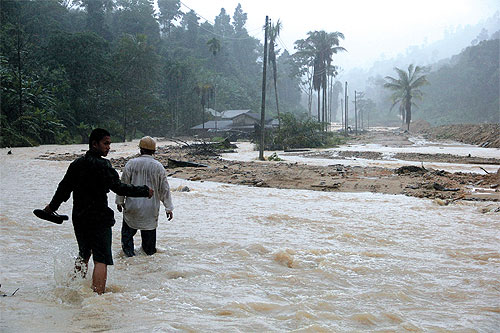
People wade through run-off sweeping through Ban Phian village of tambon Thepharat in Sichon district of Nakhon Si Thammarat province yesterday.

As floodwater started receding in the four southernmost provinces, the flooding expanded to four other provinces yesterday.

Residents in some areas were put on high alert for mudslides triggered by torrential rains which have pelted the South during the past three days.

The floods have inundated tens of thousands of homes, forcing residents to seek shelter elsewhere and causing significant economic damage.

Nakhon Si Thammarat, Chumphon, Trang and Krabi were the latest four provinces to be hit by flash flooding and mountain runoff triggered by heavy downpours.

Thousands of residents in mudslide-prone areas, including Nakhon Si Thammarat's Nop Phi Tham district, have been evacuated to safe ground to prevent a repeat of last year's tragedy.

Mudslides hit the district in March 2011, killing several people.

But flooding in the southernmost provinces of Songkhla, Yala, Pattani, Narathiwat has eased and many affected areas have dried out. Officials said all would return to normal by today as long as the rains cease.

The continuing rain yesterday caused flash floods in three districts of Nakhon Si Thammarat, including Nop Phi Tham, Sichon, and Lan Saka.

Floodwaters cut off at least six bridges and roads in Nop Phi Tham district, leaving several villages isolated from the outside world, the Disaster Prevention and Mitigation Department reported yesterday.

Nop Phi Tham district chief Preecha Koomwong said tambon Krung Ching was the hardest hit area as floodwaters washed away temporary bridges built to replace the ones destroyed by last year's flash floods.

Mr Preecha said he feared there would be more flash floods and landslides if the rain continues this week.

In Sichon district, almost 200 families living in landslide-prone areas have been moved to evacuation centres after between 20 and 40cm of rain fell during the prior 24 hours.

Nakhon Si Thammarat governor Viroj Jiwarangsan said officials had been sent to disaster-hit areas to repair roads and bridges to enable the delivery of relief supplies.

Runoff from Banthad mountain also inundated some districts of Surat Thani, Trang and Phattalung provinces.

In 11 districts of Phatthalung, about 30,000 families' homes were flooded in tambon Kuan Saothong, where water reached two metres on Sunday night.

The waters began to recede yesterday afternoon.

Meanwhile, authorities have managed to contact the eight hikers who went missing during an excursion to Khao Lon mountain over the weekend. All of them were safe.

They said communication signals was down because of bad weather.

In Chumphon, Lang Suan Hospital in Lang Suan district was inundated yesterday afternoon. The water level rose rapidly, prompting medical staff to quickly move patients and medical equipment to higher floors.

In Thung Tako district, flash floods inundated a 200-metre section of Highway 41 linking Chumphon and Surat Thani yesterday, making it impassible to motorists, who had to use a bypass road instead.

The incident caused traffic congestion along the southern road which was already crowded with motorists returning home from the New Year holidays.

The Chum Phon-Lang Suan and Lang Suan-La Mae roads were also closed due to flooding.

Science and Technology Minister Plodprasop Suraswadi yesterday inspected Thung Wua Lan beach in Pathiu district which was damaged by high waves recently.

Mr Plodprasop said the ministry was planning to install a wave detection device to warn residents of high waves before they reach the shoreline.

He also ordered local authorities to take legal action against resort operators who have encroached on public beaches.

In other news, flooding in the southernmost provinces improved yesterday as the water quickly drained out to the sea.

Hat Yai's business district was spared from flooding, which affected only three communities in Hat Yai municipality.

Songkhla governor Grisada Boonrach said the Royal Irrigation Department has sped up the draining of water out of U-tapao canal.

He said the situation would return to normal shortly if there is no more rain, although authorities plan to keep a close watch for possible flooding today. On New Year's Eve, flash floods inundated the homes of more than 20,000 people in 12 districts of Songkhla, he said.

Public Health Minister Wittaya Buranasiri yesterday said three hospitals in Songkhla were slightly damaged by the floods. Three critical patients in flood-hit Sadao district were transferred to Hat Yai Hospital on Sunday.

In Pattani, floods receded in eight districts which were hit by flash floods over the weekend.

However, residents were told to stay on alert for more flooding, especially those near Pattani and Sai Buri rivers.

Residents in six coastal districts were also warned of high waves and turbulent seas today and tomorrow.

In Narathiwat, floodwater started receding in some parts of 10 affected districts.

Villagers living in landslide-prone areas were told to prepare for evacuation after five homes at the foot of mountains in Muang and Rueso were swept away by strong mountain runoff on Sunday, while 20 others were slightly damaged.

In Yala, floodwater receded in Muang, Raman, Bannang Sata, Krong Pinang, and Yaha districts. The water level of the Pattani River, which breached its banks and inundated a number of communities on Sunday, was also receding yesterday.

Sunday, 20 November 2011

Flood death toll rises to 594

A total of 595 people were confirmed dead and two people were missing in the floods that have inundated many provinces for more than three months, the Disaster Prevention and Mitigation Department reported on Saturday.

The floods still prevail in 18 provinces, affecting 1,921,263 households, the department said.

The provinces are Nakhon Sawan, Chainat, Angthong, Ayutthaya, Lopburi, Saraburi, Suphanburi, Nakhon Pathom, Pathum Thani, Nonthaburi, Samut Sakhon, Samut Prakan, Ubon Ratchathani, Roi Et, Kalasin, Chechoengsao, Nakhon Nayok and Bangkok.

The department on Friday, Nov 18, reported the death toll at 594.

Friday, 18 November 2011

Pardon timing quizzed Chamber calls move 'strange' during floods

Business leaders are uncomfortable with the cabinet's approval of draft royal decree for a royal pardon that could include Thaksin Shinawatra, saying it could add political risk at a time when businesses are already suffering from floods.

''It sounds strange to do a thing like this as it is not the appropriate time. People are concerned about the flooding,'' said Phongsak Assakul, acting chairman of the Thai Chamber of Commerce.

The decree approved by the cabinet on Tuesday would seek pardons for thousands of convicts on the occasion of His Majesty the King's birthday next month. However, it was worded in a way that would include people convicted of corruption, notably the self-exiled former prime minister.

Academics agree: Illegal and dangerous

The first priority for government, said Mr Pongsak, remains to push water out to sea as soon as possible.

If the government cannot manage the flood, people will be increasingly unhappy because the water is becoming polluted now.

''The mood of the people can't be good,'' he said. ''Businesspeople don't want to see the government act like this, though it has the right to propose the decree as well as make political decisions.

''As long as Thailand still has water, rehabilitation and prevention measures will not happen.''

Pornsil Patcharintanakul, the chamber's vice-chairman, said the last thing businesses needed now was a political decision that could provoke protests or even riots.

He said businesses believed the government should stay focused on the big picture and maintain a balance among political, economic and social issues. If the government cannot balance these three elements, it is failing in its political role.

''Businesses feel political risk may return again so the government should rethink [the pardon] and take the opportunity to do it better,'' he said.

''Businesses have severely damaged and have no weapons. The government has to be careful and not underestimate [the impact of its decisions].''

Akapol Sorasuchart, president of the Thailand Convention & Exhibition Bureau (TCEB), suggested the government not stir up any new political conflict again as the country has already suffered a lot from flooding.

Since the end of 2008, the tourism business including the meeting, incentive, convention and exhibition sector (Mice) has suffered a lot of negative effects from political instability.

''We have been hurt severely by the flood crisis and this should be enough. The government should focus on its reconstruction plans to revive the overall economy,'' he said.

Mr Akapol said private operators already had to deal with many business risks, and political risk would re-emerge due to the approval of the royal pardon decree.

As of Nov 15, five Mice events have been cancelled and another 19 are postponed, which means the loss of 3.23 billion baht in Mice revenues.

''Private tourism and Mice operators are trying hard to recover from the flood and we need to see the confidence of foreign tourists restored. But if political problems return, their hope for recovery will disappear,'' Mr Akapol said.

The TCEB and Mice operators have launched a campaign called ''Together We Fight for Thailand'' to help restore confidence, with a budget of 40 million baht. 

Operators hope to see government agencies and private firms to spend more on meetings to spur domestic activity after the floods.

Wednesday, 16 November 2011

Yingluck: West might be flooded into New Year

The west of Bangkok might remain flooded until after the New Year, Prime Minister Yingluck Shinawatra said Tuesday.

I don't want the flood situation to extend into next year because I want see Thai people happy, but in principle I'm not confident about the situation in the west of Bangkok," Ms Yingluck said.

The premier said she had assigned Deputy Prime Minister and Interior Minister Yongyuth Wichaidit to look into the remedial measures for flood-hit households and the possibility of giving more than 5,000 baht to each household affected by flooding for more than seven days.

She also confirmed the Justice Ministry's Department of Special Investigation will investigate the allegations of corruption in the procurement of relief items.

On the Lawyers Council's plan to take legal action against the government for mishandling the flood, Mr Yingluck said, "We'll have to be patient, but we're ready to prove and provide the information."

Royal Irrigation Department chief Chalit Damrongsak said a total of 660 water pumps, with a combined capacity to drain 123 million cubic meters of water per day, have been installed along the two banks of the Chao Phraya River.

He said the situation had begun to return to normal in provinces north of Bangkok and the overall flood situation was improving steadily.

Of the 660 pumps, 387 were permanently installed at pumping stations and 273 others had been moved from provinces where there was no flooding for temporary use.

Of the total, 336 pumps had been installed along the western side and 324 on the eastern side of the river.

Mr Chalit said these pumps were being used on rotation to make sure floodwater was drained out around the clock.

The Traffic Police Division reported this afternoon that the flood level on sections of Ratchadaphisek and Lat Phrao roads had receded.

The water level on Lat Phrao Road from the Ratchadaphisek-Lat Phrao intersection to Lat Phrao Soi 39 (Soi Phawana) was down to 30cm; the water on Ratchadaphisek Road from the intersection down to Khlong Bang Sue near the Chao Phraya Park hotel also fell to 30cm.

But the roads were still impassable to small vehicles.

At the Lak Si circle, or the Constitution Monument, the water level was still high this morning.

The traffic surface around the circle was 60 to 70cm under water. It was impassable to small vehicles, reports said.

People in the area believed the high level of water was caused by the opening of a section of the barrier of big bags along Vibhavadi Rangsit Road in Don Muang district.

On Vibhavadi Rangsit Road from the five-way Lat Phrao intersection to Khlong Bang Sue, the floodwater was spreading to cover the surface of the outer frontage lanes. This part of the road was dry yesterday.

Small vehicles could now use Lat Phrao road. The deepest water, about 10cm, was in the vicinity of Soi Lat Phrao 43.

Many evacuees had returned to their houses in this area for clean-up work, the reports said.

In Thon Buri's Bang Khun Thian district, the water in Soi 69 off Rama II Road was 1.0 to 1.2m deep and was rising, but the main road was still dry and open to traffic.

Tuesday, 15 November 2011

Flood overwhelms search engine


Top ten Search in Google Zeitgeist (week of Oct 8-14, 2011)

1. ThaiFlood.com
Thai people seeking up to date information on the floods look to ThaiFlood.com
2. Navanakorn Industrial Promotion Zone
Navanakorn Industrial Promotion Zone has flooded unable to withstand the strong flow of incoming flood waters
3. thai flood
Thais search for trusted news sources through the Internet and social networks
4. terminal 21
New shopping mall in Asoke-Sukhumvij creates a unique atmosphere brining elements from around the world into one place
5. nokia 700
Latest Nokia smartphone comes in a compact size with a touch screen
6. Eel
Latest fashion in social media is to show a customized eel picture when your internet crashes
7. Flooding 2011
Thailand bravely fights against flood waters, the worst floods the country has seen in the last 50 years
8. spring news
Keep on tracking flood situations via 3G TV online on Spring News channel
9. Flood Map
Thai people urgently seek information about areas at risk and how to stay safe
10. Movie: Billionaire teenager
11. http://thailandflooding.blogspot.com/ 
12. http://thaiflooding2011.blogspot.com/
The inspiring story of a Thai teenager who succeeds and becomes a young billionaire has been made into a movie and is now showing in cinemas

Virabongsa needs to build consensus

Today sees the crucial first meeting of the Strategic Committee for Reconstruction and Future Development (SCRF), a watershed to signal whether the country will sink or swim in the face of the catastrophic flooding.

This year's seasonal floods have caused untold damage, impacting on the livelihoods of almost 3 million people, inflicting more than 530 deaths, wreaking havoc on the farmland of the Chao Phraya River basin and disrupting the worldwide supply chain for several key industries.

At issue is not the flooding, which is a natural phenomenon, but the confidence in future flood control.

The SCRF, led by Virabongsa Ramangkura, has a daunting task to prove the country's unwavering determination to prevent a repeat of flooding calamities.

Based on initial estimates, the cost of rebuilding and future flood control might range from Bt300 billion to more than a trillion baht. 

But money is not a problem. The economy enjoys a strong treasury reserve and a healthy balance of payments, while international financial institutions have offered concessionary lending terms.

In regard to technical know-how, the country can choose among several successful models on water management. Drainage experience in Japan, the United States and the Netherlands could be applicable.

Virabongsa is likely to find out that mobilising resources for flood control is the least of his worries. He will, however, encounter a most difficult challenge in forming a political consensus to implement flood-control measures.

Even the best-laid strategy would collapse like a house of cards without the necesary political backing. Unless Virabongsa can demonstrate that he is able to build confidence and consensus, the SCRF will end up in the history bin as a failed publicity stunt.

The genesis of how the SCRF was formed might be the telltale sign to remind Virabongsa how to tread the political waters.

Last week, Prime Minister Yingluck Shinawatra issued the order to form the SCRF and the Strategic Committee for Water Resources Management (SCWRM). 

Under her instruction, the two committees are supposed to work in concert to overcome the flood crisis.

Government insiders said the blueprint for the two panels came directly from former prime minister Thaksin Shinawatra, whose former adviser Pansak Vinyaratn played a lead role in drafting it. Pansak is also an SCRF member.

The blueprint was designed to achieve two objectives - shore up confidence in Yingluck's leadership, and convince investors about the commitment on future flood control.

As Yingluck and her Pheu Thai Party no longer had credibility on flood control, Thaksin reluctantly agreed to recruit Virabongsa to head the SCRF, with the prime minister set to play a supporting role for Virabongsa via the SCWRM.

Thaksin gave the green light to sideline the main coalition party so that the bureaucracy, via the National Economic and Social Development Board, could take the lead in mapping out the rebuilding strategy.

He also supported the royal initiatives on flood control as the basis for rebuilding efforts, as evidenced by the appointments of Sumeth Tantivejkul, Royon Chitdon and Kijja Polpasi. 

Sumeth and Royon are from the Geo and Agro Informatics Institute, a public organisation seen as close to His Majesty the King, while Kijja is adviser to the royal-initiated projects.

Unfolding events will reveal whether Thaksin is sincere in allowing the technocrats to take charge of rebuilding. Or he might be using them as props to sway sentiment in the face of Yingluck's nose-diving popularity.

Many suspect the ex-PM might be pulling the strings via Deputy Prime Minister Kittiratt Na-Ranong and Pansak.

If Virabongsa is to succeed in pulling the country out of its worst flood crisis and potentially an even more disastrous one in the future, then he is obligated to work in sync with Thaksin, Yingluck and the Pheu Thai Party in consensus-forming for flood-control strategy.

Monday, 14 November 2011

Flood coverage offered with KBank loans

Kasikornbank plans to offer flood insurance for mortgages from next year for a higher premium.

The bank will work with its insurance partner, Muang Thai Insurance, to develop flood insurance products in addition to its fire policies. Fire policies also cover typhoons, earthquakes, hail and riots on sliding risk scales.

The flood insurance would be offered from Jan 1, said first senior vice-president Chatchai Payuhanaveechai.

Flood protection would be in the range of 20,000 to 50,000 baht depending on the sum insured, and coverage can be increased up to 20% of the appraised value per house.

"For example, a home buyer has to pay the required fire insurance of around 500 to 1,000 baht per year for a one-million-baht house. That customer would pay an additional premium of 279 baht per year for flood protection of 50,000 baht," he said.

Existing mortgage holders can add flood insurance if the insurance company allows it. Since many people have suffered from the floods, demand for the insurance has increased, he said.

KBank projects retail loan growth of 8% this year, down from an earlier target of 15%, because of the floods. It expects sluggish housing-loan expansion into the first half of next year because of the concentration on recovery.

Housing loan growth in the first half next year will be focused mainly on rehabilitation. KBank has special packages, offering no interest for six months followed by the minimum lending rate. It offers a 15-year loan period, the longest for this type of debt, he said.

Senior executive vice-president Krisada Lamsam said the bank would provide extra financial packages to ease the financial burden for flood-affected customers, offered in three steps. 

The first step is to survey the losses, the second is business rehabilitation and the last is comprehensive financial support.

With assistance, the bank forecasts the manufacturing sector will be back to normal from the second quarter next year.

Financial measures include a grace period of up to 12 months, extension of loan maturity, and additional credit of up to 100%. Low interest rates for affected SMEs and individual customers will also be offered. The financial conditions of each applicant will be considered on a case-by-case basis.

Mr Krisada said KBank was also working with the Japan Bank for International Cooperation and its partners to provide financial support to affected customers. Six Japanese financial institutions have so far been offering assistance packages.

Bank of Ayudhya is also offering financial assistance based on cash flow, allowing new loans to help customers restart their businesses or continue normal operations.

Offers are based on the severity of the damage to assets and cash flow and each customer's track record.

Marketers, Agencies Rally During Epic Thai Flooding

Witawat Jayapani has bigger things on his mind than winning his next creative award. Instead, the co-chair of TBWA's critically awarded Creative Juice and a former chair of Thailand's Advertising Association, has spent recent days surrounding his home with 100 sandbags. 

His chief creative officer, Thirasak Tanapatanakul, has sealed his doors and windows with silicone glue before abandoning his house for a safer spot downtown. And half the agency's staff has been evacuated as at least 60% of Bangkok is underwater.

As devastating floods sweep through Thailand, marketers are finding their factories and headquarters underwater and their own staffers  as well as millions of customers  homeless. 

Mr. Jayapani estimates ad spend in a country where the top five advertisers are Unilever, Procter & Gamble, L'Oreal, Beiersdorf and Coca-Cola will plunge by at least 40% in the fourth quarter.

But unlike Japan's sudden earthquake and tsunami earlier this year, Thailand is experiencing gradual devastation as the floodwaters advance, allowing marketers some time to make plans, which are emerging as a blueprint for coping when disaster is encroaching.

Some key lessons for savvy marketers: Use ad budgets to broadcast how people can help themselves and contribute to the relief effort. Participate in that effort, whether by opening shelters or distributing desperately-needed items, by boat if necessary. 

Partner with the best relief groups, like the Red Cross. Focus on your most practical products, such as churning out bottled water around the clock or distributing your cleaning products for the recovery phase. Innovate and create new products suitable to the current calamity.

The current hit product in Thailand is a portable cardboard toilet, used with a plastic bag, from paper conglomerate SCG, which is giving away 1 million units and selling more at a nominal price.

Many marketers are realizing they don't have much choice but to pitch in. Hundreds of plants are underwater, supply chains are disrupted, and potential customers, even if they haven't lost their jobs, are hoarding money to fix up their homes and cars when the floodwaters finally recede.

Entire categories, like automotive, have stopped advertising because either their plants or their parts' suppliers are flooded.

For many in Bangkok, part of the horror is knowing the inundation is still coming.

"The anticipation is terrible and people want the water to come and then go," said Punnee Chaiyakul, chairman of Ogilvy & Mather Thailand, whose Bangkok office was about three kilometers from the floodwaters as of Friday. 

"There is little faith in the government's effort, which is why people and companies have joined together to help each other. International brands, large local companies and the general public have joined in a collaborative effort."

Coca-Cola might be the case study for best practice in a national disaster.

In early October, when it became apparent that the flooding would turn into a national emergency, Coca-Cola's Thailand team took action. The decision was made to cease all product advertising, turning over previously-purchased media to recovery and relief efforts. 

For the fifth-biggest advertiser in the country, spending close to $40 million a year, that's no small commitment, with 119 TV spots, 840 radio spots and three print ads dedicated to the message "Reunite to Relieve and Rebuild Thailand." 

Advertising aimed to raise funds and recruit volunteers for the Thai Red Cross Society and Habitat for Humanity Thailand. Coca-Cola's agency is Ogilvy.

"The current flood in Thailand is the most devastating flood we've seen during our lifetime," said Chanisa Kaewruen, marketing director for Coca-Cola in Thailand. "The overwhelming nature of the flood left millions of concerned Thais helpless."

Coca-Cola has been rallying those people to participate in mobile kitchens set up with the Thai Red Cross. And as floodwaters recede, the company will be working with Habitat for Humanity Thailand to clean up, repair and rebuild more than 590 homes and six schools and shelters across four provinces. 

Ms. Kaewruen estimates the TV spots reached 75% of the Thai public and says the company has already recruited 3,000 volunteers.

In Coca-Cola's bottling facilities, bottled water is being produced in three shifts, 24 hours a day, seven days a week. 

Two bottling plants north of Bangkok are not affected but have been surrounded by deep floodwater. Coca-Cola's headquarters in Bangkok is now inaccessible, Ms. Kaewruen said.

Creative Juice's Mr. Jayapani said he expects the still-spreading floods to last at least another month, with recovery starting in December. 

But many factories are so damaged that repairs are likely to take another three months, pushing start-up back to April 2012, he said.

As flooding continues, Bangkok's usually gridlocked traffic has disappeared as people leave their cars, often entirely wrapped in plastic, on the highest ground they can find.

Sunday, 13 November 2011

Too early for talk about committees, says Abhisit

The government must review its flood management efforts and focus more on coping with floods, Democrat Party and opposition leader Abhisit Vejjajiva said.

At a debate on the flood crisis in parliament yesterday, Mr Abhisit said he agreed with the government's move to set up a committee to rehabilitate and rebuild the country and a committee to draw up strategies for water resource and flood management.

However, Mr Abhisit said the government should not put too much emphasis on "dreaming about the future".

The task at hand is to resolve the flood woes and the government must focus on it, he said.

The government must review its flood management efforts which had failed to prevent some provinces from being hit. It must also rethink its plans to manage water in dams, he said.

Mr Abhisit went on to criticise the government for its handling of water drainage and its communication failures with the public, which hurt its credibility. 

He stressed the importance of managing donated items and relief bags in a transparent manner. Prime Minister Yingluck must ensure politics does not interfere with flood relief.

In reply, Ms Yingluck said authorities involved in flood relief were not entirely to blame. She said the flood crisis was unprecedented and manpower limited.

By the time the government took office, dams were almost full because several storms lashed the country back to back, making drainage difficult.

Thai PM: Flooding Won't Devastate Central Bangkok

Central Bangkok will see only mild flooding if it ends up falling victim to the waters that have devastated much of Thailand, the prime minister said Saturday.

Prime Minister Yingluck Shinawatra offered her prognosis on her weekly radio broadcast as the water covering parts of northern Bangkok for days appeared to be falling.

Yingluck cites flood experts in saying water in the center of the capital will not be deeper than 12 inches (30 centimeters). She acknowledged that "it is hard to say how far floodwater would get into the heart of the capital."

Some less developed, less densely populated areas north of Bangkok were submerged under more than 6 feet (2 meters) of water. The floods have killed more than 500 people since late July and caused billions of dollars in damage.

Worries about flooding are now focused to the east and west of the city center.

In the east, several industrial estates are under threat, despite flood walls and pumps. Seven major industrial estates, mostly north of the capital, already were flooded, shutting down hundreds of factories, including assembly plants for Honda and Toyota. Water has been receding there, and recovery efforts began this past week.

West of central Bangkok, floodwater may cut off the main route south from the city, Rama II Road, a situation about which Yingluck expressed concern. Authorities are working to clear an alternate route that was previously flooded.

Saturday, 12 November 2011

Compo scheme poses new obstacles

Residents battle bureaucracy to claim their 5,000 baht

Mol Plungjamras, 67, waded through waist-deep floodwater then took a taxi to Lat Phrao district office.


She had all the required documents with her - copies of her identity card, household registration record and several photos of her flooded house located behind Wat Lat Plakao, which was declared a flood disaster area.

Her aim was to claim the 5,000 baht in compensation offered by the government to people whose houses were damaged by the flood. The mission turned out to be a hard one.

"It took three hours to complete the claims process. The photos showing my flood-damaged house were in black and white because they were taken with an old mobile phone," Mrs Mol said.

Her grandchild had to take a motorcycle taxi to the nearest photo shop to have them printed out in colour.

She said no one told her the photos must be in colour. A check with the district, however, revealed that black-and-white photographs are allowed to be used to back up claims.

Mrs Mol's house and that of her daughter, who lives nearby, have been flooded for three weeks. Mrs Mol and her husband have been living on the second floor. "The sum of 5,000 baht is not enough to renovate the house, but it is better than nothing."

The cabinet has approved a 3.1- billion-baht budget to compensate people with flood-damaged properties.

The government will hand out a flat rate of 5,000 baht to each household living in a property that has been flooded for at least seven days.

Mayures Simawong, 40, said she had to take a circuitous route to get to the district office.

She and her husband, Yongyos, evacuated from their home in Chokchai 4 to stay at her workplace in the Victory Monument area last week.

"The direct route from Victory Monument to the Lat Phrao district office passes through flooded areas so we decided to go via Rama IX Road to avoid getting wet. It took a long time," she said.

Mr Yongyos said he is not sure whether he will get the compensation within 45 days as promised by the government because there are so many people affected by the flooding.

He said the government must control the price of construction materials after the crisis is over, or the 5,000 baht will be worthless.

Claimant Piyaporn Ngoenwichien, 57, said the compensation should be doubled. She had spent almost 10,000 baht trying to protect her home from the flood by hiring bricklayers to build a wall and paying people to move her motorcycles to Samut Prakan - all to no avail, as her home was still flooded.

Bophit Sengkaew, director of the Lat Phrao District Office, said he realised it is difficult for people affected by the flooding to get to his office. Staff will be sent to affected areas to make it easier for residents to register claims.

The deadline for registration is Nov 22. After that, the authorities will verify claims and decide whether residents are eligible for compensation before sending the details to the Bangkok Metropolitan Administration.

Prefab shells offer makeshift shelter for flooded Thais

Bangkok, Thailand (CNN) -- In a beehive of once-empty cement forms, a neighborhood in Bangkok's northern reaches has risen from the waters that have inundated much of the rest of the metropolitan area.

In Pathum Thani, dozens of area residents are making home in prefabricated shells intended for use in the construction of Bangkok's elevated sky-way. 

The company that owns the forms has told their new occupants they can stay, and it's letting them tap into electric lines, so there's light and television.

Most of the forms' new residents are from the same flood-ravaged community a short boat ride away. Some floated with their most prized possessions to their temporary homes here. 

Six-year-old Fai says she is content with her dry space. She and her family were flooded out of a shelter and then another home before moving here.

Next door, in the hive of cement shells, live Jaew and her family of five.

"I own a small shop and when it started to flood, I moved all my goods to my house," she said. "Then, a few days later, my house got flooded. And when the water was up to my neck, we moved here."

Jaew took CNN to see her home, which is a short boat ride away -- down a river that was once a walkway. Inside her house, her birds appeared safe and some of her furniture was drying. 

But she had no immediate plans to return. Since the flood, she said, snakes and a crocodile have been spotted nearby.

For most residents of the cement forms, there is no work and no money coming in. Volunteers come from Bangkok University each day to give them food, Jaew said. "And sometimes local officials bring us dry food and water."

Residents said they have chosen to stay in the cement confines rather than move into government shelters because they have more space and can keep an eye on their valuables. 

And, more importantly, because they are with their community. And so, in the chaos that has accompanied the floods, there is the comfort of familiar faces.

Because area schools have been closed for more than a month, children have found themselves with plenty of free time. Some have begun using the rank floodwater as a swimming pool. 

Parents say they are worried about the dirty water, but have given up trying to keep the children out.

Though people said they expect to return home when the waters recede, some said they don't expect that to happen for a few more weeks.

Floods in Thailand have killed more than 500 people since July, affecting about a third of the nation's 77 provinces.

Thursday, 10 November 2011

2012 budget offers no solutions, says Abhisit

The proposed 2.38 trillion baht fiscal budget for 2012 has set no priorities and offered no solutions to the pressing problems of the country, Democrat Party leader and opposition leader Abhisit Vejjajiva said yesterday.
Prime Minister Yingluck Shinawatra watches opposition leader Abhisit Vejjajiva on a monitor as he takes the floor during the first day of debate on the government’s 2012 Budget Bill in parliament yesterday. The debate ends today. 

Prime Minister Yingluck Shinawatra read out the government's 2012 fiscal Budget Bill to the House yesterday.

Of the total budget, the government has earmarked 120 billion baht to compensate flood victims and for post-flood rehabilitation next fiscal year.

Mr Abhisit criticised the allocation during the House budget debate yesterday and said the government's plan to spend 120 billion baht lacked details and possibly failed to guarantee transparency.

He was concerned the budget would be spent non-transparently by various ministries, because the spending of this budget will not be double-checked by parliament.

The proposed payment of 5,000 baht in compensation for each family hit by the floods will cost about 50 billion baht and the government had failed to present details on the spending of the rest of the 70 billion baht.

He disagreed with the government's plan to raise 120 billion baht for flood compensation by cutting funding from other projects.

The government proposed cutting the education loan budget by 7 billion baht, budget for free medical services by 7 billion baht, and the budget for peace-promotion operations in the far South by 3 billion baht to raise the flood compensation money.

Mr Abhisit said the government might not be able to generate its proposed income of 1.9 trillion baht during the fiscal year as expected as many industries had been damaged by flooding.

Many populist policies would also eat into the government's income.

He cited corporate tax cuts, fuel tax exemptions, the rice mortgage scheme, tax rebates for first-time car buyers, tax reductions for first-time home buyers, and 15,000 baht minimum salaries for government officials.

He also warned the government against its decision to increase the budget deficit from 350 billion baht to 400 baht, saying the rise was dangerous.

"What we are most afraid of is that finally it must collect more taxes from people and business operators, particularly small and medium ones, who are already suffering in the floods," Mr Abhisit said.

Democrat MP for Bangkok Korn Chatikavanij said the deficit increase reflected the government's intention to borrow more and there is no sign the government would try to balance the budget.

"I suggest the government postpone its plan to cut corporate income tax from 30% to 23% next January for another year.

"It could save 100 billion baht in revenue and spend that on rehabilitating SMEs hit by the floods," Mr Korn said.

"The government should also postpone first-car and first-home buying for one year because it is not an appropriate time for such costly policies," he said.

Prime Minister Yingluck insisted the government's tax privilege policies for first-car and first-home buyers should go ahead.

She said the policies would stimulate the economy and do not cost much money. The policies were promised by her Pheu Thai Party to the people so they could establish themselves with a car and home more easily.

Ms Yingluck said GDP is expected to grow by between 4.5 and 5.5% next year on the back of government spending. The debate continues today.

Foreign evacuees packed head to toe

Migrants yearn to leave, but want their pay first

A labour officer checks lists of foreign workers who were evacuated to a Ratchaburi shelter. For some, it is the third time they have moved because of flooding—first from Don Mueang airport and then from Wat Rai Khing in Nakhon Pathom.
Up to 432 migrant workers, mainly male, from flooded factories in Ayutthaya, Pathum Thani, Nonthaburi, Nakhon Pathom and Bangkok are crammed into the centre.

"They have limited space to sleep. Their heads and feet now almost touch one another while sleeping," said Sgt Maj 1st Class Somphong Kaeowannakhadi, the centre's administration chief.

A Burmese worker, 23, whose name is pronounced in Thai as Phio Phio, cannot stand living with so many people forced to share limited facilities.

She wants to return to her home in Burma and wait there until floods subside before deciding whether to return.

But she wants her employer to pay her 9,000 baht in outstanding wages first.


A soldier enters a flooded drainage shaft and places
 sandbags in it to prevent water from getting to the
 nearby Bangchan Industrial Estate through
the drainage system. 
Phio Phio and 70 workers at a rope-making factory in Phutthamonthon Sai 4 road in Nakhon Pathom recently left a flooded evacuation centre at Wat Rai Khing in Nakhon Pathom for Ratchaburi.

Ratchaburi Institute of Skill Development is running their new home. Phio Phio and her Burmese boyfriend are gripped with fears of the floodwaters.

"We had only five minutes to flee and lost most of our assets when the flood hit," said her boyfriend, 24.

The Burmese workers make up 334 of the evacuees at the centre. The rest comprise 98 Cambodians.

Rueang, a Cambodian man aged 19, wants to go back to his home in Cambodia.

He will decide whether to return to work in Thailand when the situation returns to normal.

Rueang is contacting a van operator to take him back to Cambodia.

The young man said he could leave the evacuation centre immediately because his boss had paid him his outstanding wages.

Other workers at the centre are not so lucky.

They are being forced to stay at the centre even though they might have enough money to get home, as they want their bosses to pay them outstanding wages first.

Though the evacuation centre in Ratchaburi can take up to 500 people, officials say that with money and space restrictions, they have begun to worry they cannot receive more flood victims.

The cost of looking after evacuees is straining the centre's resources, and not enough hep is coming from employers or the community.

"Employers must come to look after them. If they can't find them new places, they should at least help provide food and clear their unpaid wages," said Sgt Maj Somphong.

"I have to admit we don't have enough money and under the state policy, we need to take care of Thais first," Sgt Maj Somphong said.

The centre relies mainly on donations. It is also supported by some employers who give food to the evacuees.

Sgt Maj Somphong said he is looking for other places in Ratchaburi to be used as evacuation centres in case more foreign workers fall victim to the floods.

The number of evacuees at the centre is causing him concern, as the centre lacks space and money to care for them all. If new employers want to hire foreign workers as staff, he would be willing to let them go.

Satellites See Floods Surrounding Bangkok


On November 7, 2011, floods surrounded two industrial estates east of Bangkok, Reuters reported. On November 9 (November 8 in the United States), 

Bangkok Post described desperate attempts by officials to protect the heart of Bangkok from floods as the director of the flood relief operations command warned that more water threatened to flow into the city.

The image from 2008 shows relatively normal conditions in which the Chao Phraya River flows through a dry Bangkok. Three years later, water nearly surrounds the city, west to north to southeast. 

Floods started in northern Thailand in July and spread southward. By November 8, floods had been slowly encroaching on the Bangkok, just north of the Gulf of Thailand, for three weeks.

According to Bangkok Post, city officials were using pumps to drain overflow into the Chao Phraya River, but excess water was flowing into sewers. 

Sandbags were protecting the northern part of the city, but the director of the Rangsit Univerity disaster center warned that the sandbags would probably only contain flooding for several more days before water flowed over them and into Bangkok.

Flood approaches PM’s home

Prime Minister Yingluck Shinawatra had an unwelcome visitor to her residence in the Bung Kum district of Bangkok. Things, however, have begun to improve in neighboring Pathum Thani.

The first flood water is seen outside the home of Prime Minister Yingluck Shinawatra. 
Prime Minister Yingluck Shinawatra had an unwelcome visitor to her residence in the Bung Kum district of Bangkok.

The first flood water began collecting in front of her house. Reports said it was about 30 centimetres deep, but it had not yet flowed into the house as it was held back by a sandbag wall.

The water’s arrival is not surprising since Bung Kum is quite near the Bang Chan industrial estate which is surrounded by water and fighting to stay dry on the inside.

The Bangkok Metropolitan Administration yesterday also declared parts of the prime minister's district evacuation areas.

Bangkok Governor Sukhumbhand Paribatra said the areas are in Nuan Chan and Khlong Kum sub-districts.

People in these areas are advised to move – taking their valuables, cars and other items – to an evacuation centre or a safe place. It is especially important to evacuate children, pregnant women, sick people and the elderly.

The news wasn't all bad yesterday, however. In the neighbouring province of Pathum Thani, the flood level was slowly falling and there were high expectations in the community that the area would return to normal in about 10 days.

Flood levels have receded by about 50cm and are continuing to drop.

The water has receded significantly on Pathum Thani-Bangkok Road, a main road linking the province with northern and eastern Bangkok.

Three bus lines have resumed services on this route but smaller cars are still advised to wait until the flood situation has further improved.

Floodwaters in several housing projects in Pathum Thani's Muang district have receded by about 20 centimetres, raising hopes that the overall situation will be back to normal in about 10 days.

By then all roads in the province should be dry, with only a few low-lying parts still holding water.

Adapted from a story from Bangkok post.

approach – to move closer to someone or something เข้าใกล้
unwelcome – ไม่เป็นที่ต้องการ
residence – a place where someone lives ที่อยู่อาศัย บ้านพัก
collect – to gradually increase in amount in a place ค่อยๆ เพิ่มขึ้น
flow – (of a liquid) to move continuously in one direction ไหล
arrival – when someone/soemthing reaches where they are going ขาเข้า การเข้ามา
industrial estate – an area of land where industrial companies have their buildings นิคมอุตสาหกรรม
surrounded – having something completely around all sides ถูกล้อมรอบ

Bangkok Metropolitan Administration (BMA) – the local government of Bangkok กรุงเทพมหานคร
declare – to announce officially that something is true or happening ประกาศ ยืนยัน
evacuation – moving people from a place of danger to a safer place การอพยพ
advise – to tell somebody what you think they should do in a particular situation แนะนำ, แจ้ง
valuables – small possessions that are worth a lot of money, for example jewellery ของล้ำค่า
item – a single article or object รายการ, รายการสิ่งของ
pregnant – having a baby developing inside the body ท้อง ตั้งครรภ์
elderly – (of people) old สูงวัย, อาวุโส, อายุมาก
neighbouring – located or living near or next to a place or person ที่อยู่ใกล้เคียง, ที่ตั้งอยู่ใกล้เคียง
level – the amount of liquid that there is in a container, river, dam, etc., which can be seen by how high the liquid is ระดับ

expectations – the belief that something will happen สิ่งที่คาดหวังว่าจะเกิดขึ้นในอนาคต
community – the people living in one particular area ชุมชน
normal – typical, usual or ordinary; what you would expect ภาวะปกติ
recede – to move back; to move further away into the distance; subside ลดลง, ถอยหลัง
significantly – in an important way อย่างมีความหมาย, อย่างสำคัญ
link – to connect เชื่อม
resume – to begin again after stopping for a period of time เริ่มอีกครั้ง, กลับมาอีกครั้ง
route – the roads used to go from one place to another เส้นทาง
situation – all the circumstances and things that are happening at a particular time and in a particular place สถานการณ์
improve – to get better ดีขึ้น
overall – total; including all the things or people that are involved in a particular situation; general ทั้งหมด