Showing posts with label Flooding. Show all posts

Sunday, 13 November 2011

EM balls

SCG (Thailand) Co Ltd invited people with volunteer spirit to make one million EM balls to assist residents still affected by flooding and polluted flood water.

SCG Chemicals executive Charoenchai Prathuangsuksi said yesterday employees and volunteers gathered in Rayong to make EM balls at the Royal Project Learning Centre in Tambon Song Saleung of Rayong's Klaeng district.

Saturday, 12 November 2011

Residents clean up as floodwaters recede in west Bangkok

Bangkok residents start cleaning up as floodwater begin to recede.

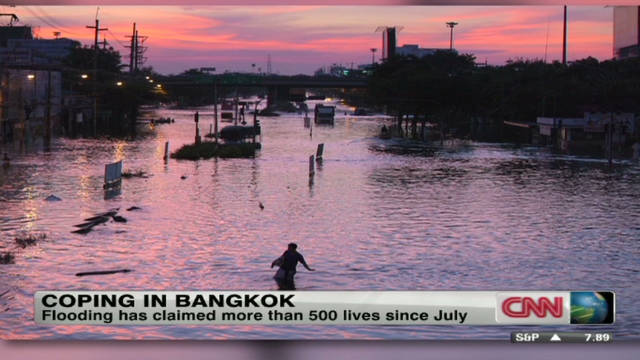
Thailand's worst flooding in 50 years started to recede in the west of Bangkok today. Waters that previously were waist-high have subsided to just below knee-level in some places.

"Water receded by around 30-40 centimeters. Now cars are able to drive on the road again, especially on Charan Road," said Bangkok resident Tawee Nisaparom.

Charan Road in Bangkok was one of the worst-hit by the floods in the west of the capital.

Bangkok authorities have announced the evacuation of 12 districts mostly in the north, east and west of the city.

As water levels decreased, residents started the task of cleaning up.

"We clean up today but will prepare again next Saturday because of the high tides," said Manasawee Pichit-Atrakul,who is also a resident.

The Royal Thai Navy has issued a warning saying there is a danger of high tides threatening to overflow Chao Phraya River over the weekend.

Bangkok authorities have announced the evacuation of 12 districts mostly in the north, east and west of the city.

Thailand's Prevention and Mitigation said 533 people have been killed since mid of July, with 2.86 million people affected by the worst flooding in five decades.

Friday, 11 November 2011

Hardship makes us stronger

Sleepless nights, with dozens of cockroaches escaping the floodwater from the sewers; days of worry about parents who refuse to flee their flooded homes; countless rides in military boats and trucks through road-turned-canals which take three times longer than usual.

Walking barefoot along the flooded roads, wading waist-deep in fetid water in the sois, buying an overpriced boat, hitchhiking, getting help from strangers and counting the days when this ordeal will end.

My personal account of Thailand's worst flood disaster in several decades might be similar to the stories told by other millions of flood-hit people.

However, what each of us has learned from this major deluge or how we have changed after this natural disaster  will not be the same.

There are many more people who are suffering greater losses and facing far more difficulties than myself. I saw a father and daughter living on small pieces of plank-wood surrounded by floodwater over a meter deep.

I saw an old, blind man try to hitch a ride on a military truck to Nawong Temple where he uses a crematorium as his temporary shelter. 

I saw a wife helping her seriously ill husband onto a 10-wheeled truck after she did failed to get any help from an emergency hotline.

I've seen the strength of the people and the ability to adjust themselves to hardship. In the first few days of the flooding, most people were fighting against the incoming water. They tried to block it, pump it out and even prayed that the water level would stop there. 

Then, we lost the battle and accepted our defeat. We moved up to the second floor, trying to think that the situation would not become too bad. But we were wrong. Electrical shocks, poisonous reptiles and hygienic problems have become major concerns. 

Toilets cannot be flushed and the piles of garbage have become bigger and bigger. Many of us decided to leave our homes, but our old folks wouldn't flee with us. They refused to live in an unfamiliar places and worry about the house, the dogs, burglars, etc.

We have no choice but to let them stay while we do everything we can to make their living condition as good as possible, while we still have to move on with our work.

At one point, everything seemed to be under control, thanks to the help of all the soldiers, state officials, rescue workers and volunteers working on the ground.

Public buses and military vehicles are my true heroes in this flood disaster. They make traveling to and from flooded areas possible. People go out to buy food and other supplies, children can go back to look after their parents and inspect their houses.

The city bus agency has been criticized for the poor condition of its vehicles. But in this time of crisis, the Bangkok Mass Transit Authority's staff and its bus fleet have proved to be a big help.

The BMTA modified its buses to be able to run on flooded roads. Where the roads along their normal route became impassable, they changed the route to serve the commuters. 

Most of the bus drivers and conductors I met were working very hard to help ease the hardship of people traveling in flooded areas.

It is basic facilities like these that help people get through a crisis, not the complicated, mulch-million-baht schemes which cabinet ministers dream up.

It has been three weeks now since the northern runoff hit the first parts of Bangkok in Don Mueang district, followed by Sai Mai, Bang Khen and Lak Si. It is good to see that many people managed to find the means to live with the water.

I recently took a ride on a crowded 10-wheeler from Chaeng Wattana Road to my house on Ram Intra Road. It was a distance of 10km and was totally flooded; it took me about two hours.

It was a pleasant trip (even if I did have to stand all the way, carrying three heavy bags of food and supplies). People from all walks of life from construction workers to well-to-do people got together on this truck. 

These strangers exchanged their flood experiences and consoled each other like friends and relatives.

I listened to them, trying to forget the growing pain in my back and legs. A famous quote of Nietzche came to mind: "What does not kill (us) makes (us) stronger."

Thursday, 10 November 2011

Flood death toll now 533

Flooding still prevails in 24 provinces, affecting over one million people, and the flood death toll has risen to 533 with two missing, the Department of Disaster Prevention and Mitigation announced on Thursday.

The 24 provinces are Bangkok, Phichit, Nakhon Sawan, Uthai Thani, Chai Nat, Sing Buri, Ang Thong, Ayutthaya, Lop Buri, Saraburi,

Suphan Buri, Nakhon Pathom, Pathum Thani, Nonthaburi, Samut Sakhon, Samut Prakan, Ubon Ratchathani, Si Sa Ket, Roi Et, Maha Sarakham, Kalasin, Chachoengsao, Nakhon Nayok and Prachin Buri.

The Public Health Ministry reported that seven people were suspected to have been infected with leptospirosis, a bacterial infection whch often spreads after flooding, in Phachi district of Ayutthaya provinces.

Seventy-two people were reported to have sufferred from diarrhoea at a condominium in Muang district of Nonthaburi. The illness was believed to have been caused by drinking raw low-quality tap water.

Exorbitant boat fees annoy

B200-500 charged for trips to mouth of soi

White-collar employees in Bangkok affected by the flooding are up in arms over exorbitant fees charged by boat owners to ferry them to work, or even to the mouth of their soi.

Some have asked the police to arrest boat operators and demanded state agencies arrange free or cheaper boat services in the city's flood-hit districts.

"It is a really expensive boat ride. I pay up to 200 baht for the short ride to work and then back home every day," said a state-enterprise official.

He said some people have been forced to pay about 500 baht for the short boat ride from their flooded communities to main roads.

Since the flooding hit Bangkok about three weeks ago, the official has taken a boat from his flooded home to Chaeng Watthana Road to catch a ride in a free military truck to his office near the Government Centre.

Tanikan Sopito, a government official, said she also has trouble travelling from her flooded house in Laksi district to work in Phaya Thai district.

Ms Tanikan said she has commuted five hours in the morning and three hours in the evening every day since her house was submerged in waist-deep water. She takes a boat ride from her home to a pick-up spot where a military truck takes her to a main road.

There, she takes another ride in a bigger 10-wheel truck to catch a bus to her office in Phaya Thai district.

"I am tired of travelling during the floods. It normally takes only about an hour," she said.

While many parts of Bangkok are under water, workers are facing difficulties travelling from their flooded suburbs to their offices, mostly in unaffected inner parts of the city.

Some have called on employers to temporarily close businesses until the water recedes, or allow them to work from home or some other suitable place. One employee with an advertising company, who asked not to be named, said her boss had called her twice, asking her to go back to work.

She and her family left Bangkok for Tak's Mae Sot district almost 10 days ago to live with friends as they could no longer endure the tap water, which had turned yellow.

"I didn't know what to do, so I told my boss that I wanted to take leave without pay for two weeks to keep both sides happy," she said.

She said she does not know how to get to work from her apartment in Bang Phlat district, which has been flooded.

One office worker, Onrasri Macmai, has been fortunate. Her office in Lat Prao district has been flooded since last Sunday.

But shortly after the flooding, her boss told all staff they could work from home.

Capital could be dry in 11 days

Half of northern runoff has flowed into the sea.


Bangkok could be drained of water in 11 days, says the Irrigation Department, presenting good news to an anxious city for the first time since northern floodwaters entered the capital.


Nearly half of the northern runoff which has devastated farmland and industrial estates and flooded parts of the capital has now flowed into the sea and the rest will be drained out soon, it said yesterday.

This year's northern runoff has been estimated at 14 billion cubic metres.

Nearly half of that amount has flowed into the sea leaving 8.5 billion cu/m in the Central Plains, said spokesman Boonsanong Suchatpong.

He said that of the 8.5 billion cu/m of water, about 3 billion cu/m is in the Chao Phraya River and 3.5 billion cu/m in the fields in the central provinces and north of Bangkok.

The rest has penetrated flood walls and inundated many parts of the capital.

As the water continues to flow into the sea, the run-off in the fields will gradually drain into the river.

Mr Boonsanong said this would leave only about 5 billion cu/m of water for the Bangkok Metropolitan Administration to manage.

With about 400 million cu/m of water being drained into the sea every day, the floodwater could be drained out of the capital in 11 days, he said.

Mr Boonsanong dismissed reports the city could be hit by a new volume of floodwater from the North.

He said the water level in Nakhon Sawan was now 1.12 metres below the river banks and the water volume that flowed downstream would not add to the flood woes being experienced by downstream provinces.

The drop in the water level in Ayutthaya's Bang Sai district and Nonthaburi's Pak Kret districts was also a good sign that less water was coming from the North, he said.

Meanwhile, the runoff from the western part of the city is approaching Rama II Road that links the city to the southern region.

The floodwater is about 1km away from the highway but it is hard to predict when it will reach and flood the road.

Bangkok Governor Sukhumbhand Paribatra said yesterday he anticipated the runoff will reach Rama II Road by today.

The runoff, which is the result of the government's attempts to divert water from the Central Plains to the west and the east of the capital, has flooded most of Phetkasem Road and Bang Khun Thian-Bang Bon Road as it heads towards Rama II Road.

The government appears to have decided not to block the floods from entering Rama II Road but instead will use the highway as a floodway to allow floodwater to head into the estuary.

MR Sukhumbhand said the BMA must protect Rama II Road from inundation.

The BMA will seek cooperation from the Highway Department to keep the highway accessible to motorists, he said.

Meanwhile, Prime Minister Yingluck Shinawatra said she has asked Thai Airways International to put on extra flights at discounted rates for travellers going south in case Rama II road is inundated.

In Bang Phlat, one of the worst-hit districts in the western part of the city, the floodwater in several areas has receded by 10cm.

A section from Krung Thon Buri bridge to Bang Phlat intersection is now passable to motorists with a water height of 20cm.

Motorists were having a difficult time on Sirindhorn and Charan Sanitwong roads because the water levels differ along these roads.

In some parts the floodwater had fallen to 20-30cm, but other sections remain under 80cm water.

Residents in Bangkok Yai district are keeping their fingers crossed that run-off from Phetkasem Road will not reach Tha Phra intersection.

The district has deployed 18 pumps at Khlong Bangkok Yai's sluice gate to drain water from the canal to the Chao Phraya River.

During high tide today and tomorrow, communities along the Chao Phraya River on the western side of Bangkok, Pathum Thani and Nonthaburi and Samut Prakan's Pak Nam have been urged to keep vigilant.

The water in the river will rise by 10cm above mean sea level during high tide.

The BMA has issued an evacuation warning for Ram Intra and Kannayao sub-districts of Kannayao district, while Lat Phrao sub-district in Lat Phrao district was put on close watch.

Seri Supparathit, director of Sirindhorn International Environmental Park, said the "big bag" flood barrier north of Bangkok will slow down the run-off which would finally overflow the barrier within a week.

The barrier will hold the water for seven days before the overflow starts," he said. "Khlong Bang Sue will be in trouble and the flood may affect the Victory Monument."

Flood Relief Operation Command director Pracha Promnok admitted yesterday the water might overflow the flood barrier, but insisted it would not fall.

He said the barrier would be able to hold the mounting water pressure and last for months.

Wednesday, 9 November 2011

Flooding has huge effect on Thailand's capital

While 60 percent of Bangkok and much of Thailand is flooded, the downtown area where I'm staying on my way back from consulting in Bangladesh is dry.

But signs of the flooding are everywhere.

Overpasses are lined with cars parked to keep them high and dry. In anticipation of more water, many shops and businesses have erected temporary barriers of bags or small concrete blocks a couple of feet out from their storefronts, forcing people to climb over them to get in.

 Street vendors selling sandals have added calf-high plastic wading boots to their inventory.

A Bangladesh regulator told me that he had to return early from medical treatment in Bangkok because nurses and technicians either couldn't get into the hospital or left to help family in flooded areas.

Thai media provide constant updates and reports of consequences ranging from rescue efforts to pictures of policemen crossing intersections on bamboo rafts and stories of imported serums to treat poisonous snake bites.

Bangkok is frequently a layover for me on consulting or adventure trips, and every so often I inadvertently find myself behind barriers of some kind. In 2006, my walking group somehow wandered behind barbed wire fences erected during protests by the "red shirts," one of the country's political movements.

In 2008, it happened again. This time, I found myself behind tire barriers erected during protests by the "yellow shirts," the other political movement. Two days after I left Bangkok, the demonstrators shut down the airport, stranding passengers for days.

This time, I'm behind water barriers. I've felt no need to worry here, but I wonder about once again being lucky enough to leave just in time.

A big mass of water still surrounds Bangkok. At the time of this writing, the deluge is slowly creeping into new roads and intersections. 

One side of the city has been told that nothing can be done to drain the water mass from the main canal. Another major canal is expected to overflow soon.

The Skytrain and subway are still running, but some underground subway exits have been closed as a precaution.

Tuesday, 8 November 2011

Choked by best intentions

For months now floodwater have wreaked havoc on the lives and livelihoods of so many Thais in 25 provinces. The force of the water has clearly shown its wrath and power, inundating not just industrial estates and businesses but the homes of millions of people.

Yingluck Shinawatra waves to flood victims in flooded Laksi district of Bangkok on Monday, after distributing relief supplies.

And it is not yet over _ as the floods continue to advance towards the inner parts of the capital. The damage continues to climb in terms of financial losses.

But worst is the loss of life, which has now tipped over 500. Human misery continues to climb as many are suffering under intolerable conditions. So many have lost everything they have worked and toiled for all their lives. And for so many, no compensation will be enough.

In these dark and dire times we have seen the best and the worst of human nature. But there can be no doubt that the people and this country will survive this disaster. There can be no doubt that the undeniable spirit of the Thai people will eventually prevail and rise once again.

What clearly remains in doubt, however, is whether the Thai people can rely on the necessary collective leadership to implement the right measures, indeed make tough decisions, to ensure that a similar disaster will not occur again.

And I don't just mean the necessary leadership qualities of Prime Minister Yingluck Shinawatra and her cabinet. I also mean the necessary leadership of the opposition as well.

There is no doubt that Khun Yingluck has all the good intentions; she is determined and is trying her best to deal with this disaster. In fact, I do feel sorry for her as this challenge of premiership was thrust upon her. And she really did not have any time to learn the ropes, so to speak, before this disaster finally spilled over.

This disaster has shown that inexperience in working and dealing with the bureaucracy and the politicians, as well as the differing and conflicting views of experts, academics and advisers, has resulted in missteps by the prime minister.

As prime minister, she could not initially control the outburst of Science and Technology Minister Plodprasop Suraswadi. She was unaware of the "New Thailand" proposal which suddenly popped up. She flip-flopped on the Khlong Sam Wa sluice gate incident.

The fact that many of her ministers are simply greenhorns in running the country or have proven ineffective in dealing with this crisis, has not helped.

Even amidst this crisis, there have been reports that Pheu Thai Party's de facto leader Thaksin Shinawatra is unhappy with the performance of certain cabinet ministers for providing wrong information about the flood problem to the prime minister and that those assigned to lead flood relief and post-flood rehabilitation have failed in their tasks.

Internal finger-pointing within Pheu Thai does not erase the fact that as far as Prime Minister Yingluck is concerned, good intentions and determination are simply not enough.

In terms of much-needed leadership in national administration, she has been challenged, measured and, sadly, been found sorely wanting. And if she is drowning now, what chance is there that the right decisions of rehabilitation and revival would be made when the floodwater finally recede and the full force of vested interests and politics comes to the fore?

I do believe that a more experienced leader would have done a better job. Love him or hate him, we must admit that Thaksin Shinawatra would have done a better job.

Likewise with Abhisit Vejjajiva. Both have had experience in working and dealing with Thai bureaucracy and would have handled the lack of coordination between the Royal Irrigation Department and the Bangkok Metropolitan Administration better. 

They have sufficient political mileage under their belts to ensure that slip-ups by ministers would not be glaring, and that wrong messages would not slip out.

Even so, I don't believe either of these political leaders would have been able to stop or stem the flooding we are currently facing. It is easy to say that we have borne the brunt of more than our fair share of tropical storms and rainfall. We are facing the current disaster, in part, because of gross water resources mismanagement.

In 1995 His Majesty the King advised and warned that we have allowed factories and industrial estates to be built in natural water catchment areas. They are located in areas where floodwater naturally flow. His Majesty further advised that waterways needed to be constructed to ensure that these estates do not get flooded.

His Majesty also noted that encroachment had occurred in many of the canals snaking through Bangkok and in surrounding provinces.

The king urged reclamation of these canals so that flood waters could flow and drain more efficiently. The king also suggested that a flood-way should be constructed to avoid a repetition of the 1995 floods which struck Bangkok.

His Majesty gave all this advice 16 years ago. Sadly, and clearly, our political leadership then, and now, have not heeded the king's advice.

What is more saddening than having a prime minister who is overwhelmed, is that after the floods are drained, we will still be stuck with a lack of political leadership in the government and the opposition  to work together and lead the people and this country towards a national agenda of revival and rehabilitation.

My fear is that bitter bickering, finger-pointing and politicking will re-emerge. I doubt whether the prime minister and her cabinet will have the guts to make the necessary changes in policy, and set aside what they promised before the elections in order to focus on what really needs to be done on rehabilitation, to ensure that a similar disaster does not happen again. I would dearly love to be proven wrong.

Thousands refuse to leave as floodwaters threaten central Bangkok


Murky floodwater is slowing moving towards the heart of the Thai capital Bangkok as thousands of people ignore orders to evacuate the city.

Relief workers are distributing aid to evacuation centers in central Bangkok, but they say they are struggling to reach residents still refusing to leave their homes.

"I believe thousands of people are in their homes and are still not evacuating," relief co-ordinator Rungsun Munkong told CNN. "(They) possibly will be stranded with little food and water as time goes by."

He says other agencies have attempted to reach people trapped in tower blocks "but the scale is just massive."

"I think it will be difficult down the road to get help to these people," Munkong says, adding, "People need clean water, that's the first important thing. Cooked ready-to-eat food is also quite important, baby milk and so on."

Thailand has been inundated with its worst flood in half a century, affecting at least 25 of the country's 77 provinces.

More than 500 people had been killed in the deluge according to figures released Sunday by the country's interior ministry.

A Thailand Disaster and Mitigation Department report, issued Sunday and reported by MCOT, estimated about 3.1 million people have been affected and 4 million acres of farmland have been damaged. Moreover, the department said two people are believed missing and about 75 highways have closed.

In the provinces of Nakhon Sawan and Ayutthaya, cleanup efforts were under way.

On Sunday, the Prime Minister Yingluck Shinawatra visited Nonthaburi, near Bangkok. There, the government provided 100 boats to help transport people and disperse relief supplies after requests by local officials, according to MCOT.

Despite public criticism of the government's overall response, Yingluck said she would not shake up her Cabinet -- in the short-term, at least.

She explained that the focus first is to address the situation, with a full evaluation and possible shuffling to be done after the crisis abates, reported MCOT.
I think it will be difficult down the road to get help to these people
Rungsun Munkong, relief co-ordinator

Floods are an annual occurrence in the country but have been particularly acute this year, and some residents and analysts have criticized the government's response.

"Now the government is sending a mixed signal that the situation is fine, but the truth is it the situation far from over," political analyst Supong Limtanakul told CNN. "It is a slow suffocating death of (the) Bangkok business area."

The city's main airport and two large industrial sites are also at risk, Supong said.

Supong said the government did not have enough resources to deal with floodwaters, noting that officials had recently asked the private sector for water pumps to help drain water out of Bangkok.

Paribatra, Bangkok's governor, told MCOT that it may take up to two weeks to drain water out of Bangkok's main roads, and months to drain water from smaller roads.

Friday, 4 November 2011

Activists Dive In to Help Dogs Abandoned in Floods

Activists work to save dogs that have been lost or abandoned amid the floods in Thailand.

Even in the midst of the worst floods to hit Thailand in decades, the kingdom’s furry friends have not been forgotten. Animal welfare groups are mobilizing activists and volunteers all over the world to help save and protect dogs, cats and other domestic animals from the floods.

A dog sat on a divider in a flooded street near the Chao Praya river in Bangkok.


Large-scale evacuations that have affected thousands of people in the capital have left many animals abandoned, as evacuees are typically not allowed to take their pets with them to shelters. This, coupled with a large number of stray dogs and cats already roaming the streets of Thailand, has prompted animal welfare groups to appeal for emergency assistance for the animals.

Thailand’s Soi Dog Foundation (“Soi” means “alley” in Thai), based in Phuket, has teamed up with other animal welfare organizations like Treat With Responsibility and Empathy All Animals in Thailand (Treat), Chulalongkorn University Small Animal Clinic and Soi Cats and Dogs (SCAD), enlisting high-powered boats and volunteers to save the stray, hungry animals.

Volunteers traverse flooded streets on small boats, armed with cages to pick up the frightened dogs, often at the risk of being bitten by animals not accustomed to human beings. The dogs are then brought to animals shelters in drier areas of the country. According to animal activists, rescue operations are getting tougher now because the sheer number of dogs and the vast areas that are now being flooded.

“We thought the situation was getting better, but it is really dire again,” said Margot Homburg of Treat Bangkok, a nonprofit animal welfare organization that runs a clinic for unwanted and street animals in Bangkok.

Worsening floods in many areas, now spreading into new parts of Bangkok, have forced more evacuations — including of Treat’s own low-cost veterinary clinic for street animals in Bangkok. The clinic’s staff and more than 80 dogs, a monkey and a rabbit have now been evacuated to a shelter in the Cha-am area, where more than 300 dogs are being housed.

Soi Dog Foundation puts the number of dogs and cats at risk at 60,000 to 80,000, according to Leonard Coyne, a spokesperson for the nonprofit organization. The group has enlisted 75 to 100 volunteers to help with animal rescue efforts, and is currently working with the Humane Society International and World Vets to help control what they describe as an “extremely dire situation.”

Most of these animal welfare groups have prominent pages on their websites’ homepages asking for donations. Food and cages to transport the animals are scarce. Additional donations are also being requested to sterilize the animals.

The Soi Dog Foundation, meanwhile, has put out a request for large boats, as volunteers say the current smaller boats being used to rescue and transport pets are not big enough to carry the increasing numbers of large dogs that need rescuing. According to John Dalley, coordinator of Soi Dog Foundation’s rescue efforts, two such boats were purchased today and are being sent up from Phuket.

Many of the rescued dogs have been abandoned by owners who are unable to take their pets while evacuating flooded homes. Some dogs left behind are able to stay in their owners’ houses without too much risk, so volunteers leave food for them rather than taking them back to crowded shelters.

“Dogs are simply left behind, there are such a vast number of them,” said Ms. Homburg of Treat. “It is horrible and heart-wrenching and the problem is just beginning. After the water is gone, there will be huge numbers unable to return…what on earth do we do with them?”

Ms. Homburg said she has also seen dogs in the rescue center that have been attacked by some of the other wild animals roaming around in floodwater — particularly crocodiles.

Rescued dogs and other animals housed in shelters like the one in Cha-am are sterilized. The animals are provided with medical treatment if necessary, and given food and water — though a significant amount of donations are still needed to keep the animals fed and sterilized, workers say.

Bangkok-based animal activists said they had been receiving calls from places like South Korea, Canada and Australia, eager to send volunteers, food, money and cages. More volunteers are on their way, including vets — though these people, too, have to struggle to find shelter while helping the abandoned creatures.

“Feeling so powerless and not being able to help more is nerve-wrecking,” said Ms. Homburg. “It is an understatement to say that the logistics involved of the scale we’re dealing with here, rescuing animals in flooded areas… goes well beyond any of us have ever imagined to be involved in.

Thursday, 3 November 2011

Floods arrive at Major Ratchayothin

The northern flood moving in from upper Bangkok on Thursday morning surrounded Major Cineplex Ratchayothin on Phahon Yothin road, reports said.

The floodwater flowed to the entertainment and shopping center through both Ratchayothin and Phahon Yothin roads, forcing it to shut down.

The public relations office of the Major Cineplex Group announced the closure of its theatre and shopping mall at Ratchayothin for the rest of the day.

Traffic police at Phahon Yothin police station said the outbound lanes of Phahon Yothin from Major Ratchayothin to Kasetsart intersection were submerged and impassable for all vehicles.

The inbound lanes from Kasetsart University to Central Lat Phrao department store were still open for traffic but only a few cars were using them as small vehicles could not pass through the Kasetsart intersection.