Tuesday, 3 January 2012

Flooding brings grief to more southern provinces Tens of thousands of homes are inundated

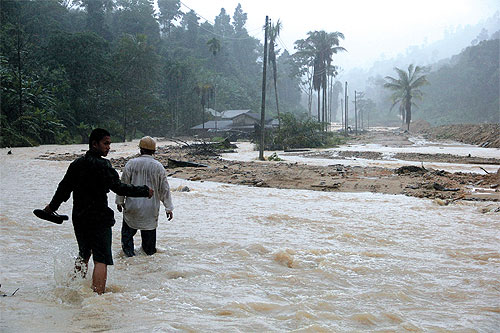
People wade through run-off sweeping through Ban Phian village of tambon Thepharat in Sichon district of Nakhon Si Thammarat province yesterday.

As floodwater started receding in the four southernmost provinces, the flooding expanded to four other provinces yesterday.

Residents in some areas were put on high alert for mudslides triggered by torrential rains which have pelted the South during the past three days.

The floods have inundated tens of thousands of homes, forcing residents to seek shelter elsewhere and causing significant economic damage.

Nakhon Si Thammarat, Chumphon, Trang and Krabi were the latest four provinces to be hit by flash flooding and mountain runoff triggered by heavy downpours.

Thousands of residents in mudslide-prone areas, including Nakhon Si Thammarat's Nop Phi Tham district, have been evacuated to safe ground to prevent a repeat of last year's tragedy.

Mudslides hit the district in March 2011, killing several people.

But flooding in the southernmost provinces of Songkhla, Yala, Pattani, Narathiwat has eased and many affected areas have dried out. Officials said all would return to normal by today as long as the rains cease.

The continuing rain yesterday caused flash floods in three districts of Nakhon Si Thammarat, including Nop Phi Tham, Sichon, and Lan Saka.

Floodwaters cut off at least six bridges and roads in Nop Phi Tham district, leaving several villages isolated from the outside world, the Disaster Prevention and Mitigation Department reported yesterday.

Nop Phi Tham district chief Preecha Koomwong said tambon Krung Ching was the hardest hit area as floodwaters washed away temporary bridges built to replace the ones destroyed by last year's flash floods.

Mr Preecha said he feared there would be more flash floods and landslides if the rain continues this week.

In Sichon district, almost 200 families living in landslide-prone areas have been moved to evacuation centres after between 20 and 40cm of rain fell during the prior 24 hours.

Nakhon Si Thammarat governor Viroj Jiwarangsan said officials had been sent to disaster-hit areas to repair roads and bridges to enable the delivery of relief supplies.

Runoff from Banthad mountain also inundated some districts of Surat Thani, Trang and Phattalung provinces.

In 11 districts of Phatthalung, about 30,000 families' homes were flooded in tambon Kuan Saothong, where water reached two metres on Sunday night.

The waters began to recede yesterday afternoon.

Meanwhile, authorities have managed to contact the eight hikers who went missing during an excursion to Khao Lon mountain over the weekend. All of them were safe.

They said communication signals was down because of bad weather.

In Chumphon, Lang Suan Hospital in Lang Suan district was inundated yesterday afternoon. The water level rose rapidly, prompting medical staff to quickly move patients and medical equipment to higher floors.

In Thung Tako district, flash floods inundated a 200-metre section of Highway 41 linking Chumphon and Surat Thani yesterday, making it impassible to motorists, who had to use a bypass road instead.

The incident caused traffic congestion along the southern road which was already crowded with motorists returning home from the New Year holidays.

The Chum Phon-Lang Suan and Lang Suan-La Mae roads were also closed due to flooding.

Science and Technology Minister Plodprasop Suraswadi yesterday inspected Thung Wua Lan beach in Pathiu district which was damaged by high waves recently.

Mr Plodprasop said the ministry was planning to install a wave detection device to warn residents of high waves before they reach the shoreline.

He also ordered local authorities to take legal action against resort operators who have encroached on public beaches.

In other news, flooding in the southernmost provinces improved yesterday as the water quickly drained out to the sea.

Hat Yai's business district was spared from flooding, which affected only three communities in Hat Yai municipality.

Songkhla governor Grisada Boonrach said the Royal Irrigation Department has sped up the draining of water out of U-tapao canal.

He said the situation would return to normal shortly if there is no more rain, although authorities plan to keep a close watch for possible flooding today. On New Year's Eve, flash floods inundated the homes of more than 20,000 people in 12 districts of Songkhla, he said.

Public Health Minister Wittaya Buranasiri yesterday said three hospitals in Songkhla were slightly damaged by the floods. Three critical patients in flood-hit Sadao district were transferred to Hat Yai Hospital on Sunday.

In Pattani, floods receded in eight districts which were hit by flash floods over the weekend.

However, residents were told to stay on alert for more flooding, especially those near Pattani and Sai Buri rivers.

Residents in six coastal districts were also warned of high waves and turbulent seas today and tomorrow.

In Narathiwat, floodwater started receding in some parts of 10 affected districts.

Villagers living in landslide-prone areas were told to prepare for evacuation after five homes at the foot of mountains in Muang and Rueso were swept away by strong mountain runoff on Sunday, while 20 others were slightly damaged.

In Yala, floodwater receded in Muang, Raman, Bannang Sata, Krong Pinang, and Yaha districts. The water level of the Pattani River, which breached its banks and inundated a number of communities on Sunday, was also receding yesterday.

Saturday, 17 December 2011

Panasonic puts the ball in the government's court

Panasonic Group, the Japanese consumer electronics giant, wants to keep production in Thailand, but the final decision will depend on government efforts to improve infrastructure and flood prevention.

Panasonic operates 12 factories in Thailand and one flooded in Rojana Industrial Park and two more in Nava Nakorn.

Hirotaka Murakami, chief executive officer of Panasonic Group, said that since the floods began, the Thai operation has never raised the issue of withdrawal from Thailand with the parent firm.

Panasonic wants to see what the Thai government does about transportation, logistics and wages, he said at a press briefing yesterday.

"Rising wages is a concern. On one hand, higher wages can help drive the country's economy in the future. However, we do not want to see high inflation in the long term," he said.

Panasonic Group has been in Thailand for 50 years with 22 firms under its umbrella, 12 of them factories.

Total group sales for the current fiscal year ending next March 31 are expected to reach 100 billion baht, up by 20% from the previous year.

Floods have affected the production of Panasonic plugs, switches and hair driers, with damage still being assessed.

The group plans only minor investments in Thailand next year.

Yesterday it launched the Lumix GX1 and Lumix X Series lens, a new digital still camera and lens for professionals.

Pinyo Piromthan, the digital camera product manager at Panasonic Siew Sales (Thailand) Co, said his company expects to sell 5,000 units of the Lumix GX1 over the next few months.

He said mirror-less digital cameras have shown dynamic global growth. The market share of mirror-less digital cameras in Singapore is 25% of the total digital camera sales, rising to 34% in Japan and dipping to 11% in Europe.

About 1.35 million digital cameras will be sold this year in Thailand, of which 1.25 million units will be compacts, 92,000 units digital SLR and 18,000 units mirror-less digital cameras.

Sales of Panasonic Siew, covering audio-visual products, and Panasonic AP Sales, which sells home appliances such as air-conditioners and refrigerators, should reach 22 billion baht combined in the current fiscal year, up by 10% from last year.

Harpists come to the fore

The Tamnak Prathom Harp Ensemble will perform at Tamnak Prathom Heritage Home on Sun, Dec 18 from 10am-6pm and at Phra Rathaniwet Maruekhathayawan Palace on Dec 25 at 2pm.

The Tamnak Prathom Harp Centre presents two charity events to help raise funds for the Red Cross Flood Relief programme. 

The "Flood Aid Festival and Mini Music Marathon" will take place at the Tamnak Prathom Heritage Home on Sunday, December 18 from 10am-6pm and the 

"Thai Songs from the Harp Strings Celebrating the Great Month of December" concert is scheduled for Christmas Day, December 25 at 2pm at Phra Rathaniwet Maruekhathayawan Palace in Phetchaburi province.

The first event packs music, games, exhibitions and lucky draws. The day starts with a guided house tour (donation 50 baht), followed by a demonstration of how to make khon masks, Thai puppets, costume embroideries and carving.

Music will be presented in the afternoon by two celebrity artists _ Yani Tramoj and violinist Paye-Srinarong from Vie Trio, with a different programme every hour including music by a five-flute ensemble, a guzhoeng ensemble and a jakae ensemble. 

The finale sees the Tamnak Prathom Harp Ensemble featuring internationally reputed harpists Jimin Lee, Jie Zhou and Alina Bzhezhinska.

Tamnak Prathom is the heritage home of HRH Prince Chudadhuj Dharadilok, son of King Rama V. It is located in Ngam Wong Wan Soi 2 in Nonthaburi.

The concert on December 25 will feature traditional Thai music, classic songs and some of HM the King's compositions including Kinari Suite to be performed by the Tamnak Prathom Harp Ensemble and Paye-Srinarong who will also double as MC.

Froc winds down after frenetic time Its offices sit empty, but staff are proud of their work

As the Flood Relief Operations Command (Froc) winds up, team members have told of their struggles in dealing with the biggest flood Thailand has witnessed in 50 years.

Empty chairs and tables now fill the hall once abuzz with people from the Government Public Relations Department and reporters.

The lights are dim, and cables and wires are strewn across the floor, ready to be packed and stowed away.

Barely any traces are left of the sandbag walls and elaborate flood barriers that protected the Energy Complex building which served as the Froc headquarters.

On Dec 8, the Froc's downsizing began following talks between its director Pracha Promnok and governors of seven provinces that remain flooded.

The Froc reduced its staff from over 2,000 to just 200, and all offices were consolidated on the 15th floor.

Anurak Khajonrit, an HR officer at the Secretariat of the Prime Minister, was transferred to the Froc when the centre was still located at Don Mueang.

He recounted the mayhem when the Froc had to escape the floodwater at its Don Mueang base on Oct 28.

"It was confusing and chaotic. No one thought that the flood would break through. People were in disarray. We didn't know where to go," 

Mr Anurak said. "All officials and volunteers, as well as reporters, were forced to flee as the water burst open a 30m gap and quickly swamped the airport. The breach took everyone by surprise."

A fevered scene ensued when electrical power was cut and startled officials tried to save important documents and computers while fleeing.

Later, the command was told to relocate to the Energy Complex down Vibhavadi Road. Mr Anurak said the relocation was confusing at first.

Once the dust settled, however, the Froc's work became more systematic and organised than it bad been at Don Mueang. 

"Previously, the Froc consisted of government officials, volunteers and other third-party organisations. Control and management were difficult, even more so when you had to cater to a constantly fluctuating number of people," he said.

More security measures were imposed at the Energy Complex and many people were barred from entering the building.

Despite criticism of the Froc for its handling of donations and poor communications, Mr Anurak said he is happy he had the chance to contribute and he would do so again.

"I am proud to have taken part. The Froc's main objective was to help people in need and its closure means the task is complete and the Froc has fulfilled its purpose," he said.

Somsak Danjatupong, 52, a security officer, said his main duty besides guarding the facility was helping people who visited the Froc to submit petitions.

"It felt great getting to help these people. Obviously they were suffering to submit a petition. My duty was help them do it successfully in an orderly fashion," Mr Somsak said.

Regarding criticism of the Froc's efficiency, Mr Somsak said the help was there but was sometimes delayed because of bureaucracy and politics.

More unity and selflessness and less politics is needed during such times of crisis, he added.

Chaturapoom Phatong, 18, an audio-visual employee at the Energy Ministry, was in charge of coordinating requests for relief bags. He understood the needs well, he said, because he was a flood victim himself.

He said the biggest problem was that people did not understand the system. They came in with no request letters or petitions and expected to receive the relief bags right away, he said.

At first, work at the Froc proceeded slowly because everything had to be approved first by the director. The command adapted gradually, and the process of approving aid requests was cut down to within a day or two.

Flood toll: 740 deaths, 3 missing

The combined flood toll nationwide is now 740 deaths with three missing, the Disaster Prevention and Mitigation Department reported on Friday.

Altogether 3,652 villages in 80 districts of nine provinces in the upper part of the country are still sufferring from the flood. 

 They are Ang Thong, Ayutthaya, Lop Buri, Suphan Buri, Nakhon Pathom, Pathum Thani, Nonthaburi, Samut Sakhon, and Bangkok. The accumulated flood toll in this part of the country is 730 deaths with three missing.

In the South, flooding has hit 2,057 villages in 65 districts of Phatthalung, Trang, Surat Thani, Nakhon Si Thammarat, Narathiwat, Songkhla, Yala, and Pattani, causing extensive damage to farm land and public facilities. The death toll in these southern province is 10.

Kids flooded with relief as schools reopen Bored youngsters eager to lend a hand with big classroom clean-up

Students from Donmuang Taharnargardbumrung School inDon Muangdistrict wash desks and other classroom items damaged by the recent flood. The school reopened on Tuesday, but most of the compound and equipment has yet to be cleaned up. 

Students returning to flood-affected schools after enduring a delay of more than a month to the start of the new semester are joining in a new extra-curricular activity - cleaning up in the wake of the deluge.

Nuttaleeya Saengsung, a Matthayom 5 student from Donmuang Taharnargardbumrung School in Don Muang district, which reopened on Tuesday, said the beginning of this semester was different from previous ones.

Now, she said, students not only study in the classrooms but also spend some of their spare time helping to clean them up, as well as other parts of the school compound that have been left in a mess after the flood receded.

Even before the semester started, many students went to the school as soon as it was dry to begin the clean-up.

"Even now, we haven't finished," said Nuttaleeya, 17, as she took a break from scrubbing filthy desks.

Normally, students would sing the morning national anthem and then head straight to their classrooms, but for now students and teachers scatter around the school's compound and get to work on the clean-up, with lessons getting under way later.

Some removed damaged chairs, tables and cabinets from the classrooms, while others washed educational equipment and collected litter.

"The school smells like a wet market, but we are very happy it was finally reopened after several postponements," Nuttaleeya said. "I was dying to see my friends again."

The Education Ministry originally set the opening of the second semester for Oct 25, and then postponed it repeatedly, first to Nov 7, and then to Nov 21 and again to Dec 6 due to prolonged floods. Finally the institutions were free to open their doors again last Tuesday.

The Bangkok Metropolitan Administration also postponed the opening of flooded schools under its supervision from Nov 1 to Dec 6 and then Dec 13.

Warisara Rodchim, also a Matthayom 5 student at Donmuang Tahanargardbumrung School, said the traffic congestion had become worse in the post-flood period due to the huge amount of debris piling up on the roads and damage to their surfaces.

She has to spend more time travelling from her home in Khlong 3 of Pathum Thani to the school.

"Now, I feel a little bit worried that students at flood-hit schools will be unable to catch up with those unaffected by the floods," she said.

The school's director, Rujisak Nakphong, said the floods had caused an estimated 2.6 million baht in damage as the 45-rai compound was under about 1.5m of floodwater for 45 days.

He said about 80% of the 3,500 students were able to attend the school on the opening day.

Mr Rujisak believes the remaining 20% must still be affected by the floods, and says if they fail to show up by next week, the school will send teachers or classmates to visit them at their homes to see if they need any help, Mr Rujisak said.

He added the curriculum has been adjusted and all students must now attend a catch-up class on Saturdays throughout the second semester.

The school is expected to have completely returned to normal within two months, he said.

In Nonthaburi province, flood-devastated Bang Bua Thong School also opened on Dec 13, even though its large football field remained under a metre of floodwater.

Like their Bangkok peers, the Bang Bua Thong School pupils were also busy cleaning up their classrooms in addition to resuming their studies.

Some students wore casual clothes as their uniforms had been washed away in the deluge.

"I really missed my friends and felt bored as I was stuck in the upstairs of my house for more than a month," said Ratsamee Cheuraman, a 17-year-old student at Bang Bua Thong School whose house in Nonthaburi's Bang Yai district was inundated.

Now, her house is completely dry.

"I am very happy to go back to school, but I am afraid that the compound will be flooded again next year, as many people predict," she said.

The school's director, Narakorn Lailang, said the floodwater will be drained from the football field by early next week.

"The school was 100% flooded. Water levels were between 1.5m to 2m for nearly two months," he said.

However, he said that one good thing to emerge from this trying time was that the returning pupils showed a renewed appetite for learning and a stronger sense of community in their school than had been the case before.

Students in Bang Bua Thong School also have to study on Saturdays for the time being.Pitsanu Tulasuk, deputy secretary-general of the Office of Basic Education Commission, said 2,209 schools were affected by the floods across the country.

As of now, 24 ministry-run schools in Pathum Thani, Nonthaburi and Nakhon Pathom remain closed because of persistent high floodwater levels in their campuses.

The cabinet recently approved a budget of 456 million baht to purchase textbooks, learning tools and uniforms for affected schools. Another 422 million baht has been set aside for renovating damaged school buildings.

Royalist protest at UN building draws 200 US embassy clarifies ambassador's remarks

Supporters of the right-wing Siam Samakkhi (United Siam) group protest in front of the US embassy calling on it to stop interfering in Thailand’s lese majeste law following the US ambassador’s recent comments on prosecutions conducted under the law. 

The Siam Samakkhi group has called on officials from the United Nations and the US government who made comments on the lese majeste laws to apologise for interfering in Thailand's internal affairs and for being disrespectful to the judicial system.

About 200 supporters of Siam Samakkhi, a right-wing political network, yesterday gathered in front of the United Nations building on Ratchadamnoen Nok Avenue to protest against the UN's call for an amendment to Section 112 of the Criminal Code, also known as the lese majeste law.

A UN expert on rights protection and freedom of expression in October urged the government to amend Section 112 and the 2007 Computer Crime Act, saying the laws were too vague and the harsh criminal sanctions went against universal norms.

Earlier this month, Ravina Shamdasani, acting spokeswoman of the UN High Commissioner for Human Rights, expressed concern about "harsh sentencing of people convicted of lese majeste and the chilling effect this is having on freedom of expression". 

Her remark followed the sentencing of Ampon Tangnoppakul, 61, to 20 years in jail for sending four text messages deemed offensive to the monarchy on Nov 23. 

On Dec 8, a US citizen, Thai-born Lerpong Wichaikhammat, 55, was jailed for two-and-a-half years for using the internet to disseminate information that insulted the monarchy.

In the letter, the Siam Samakkhi Network called on the United Nations to "stop whatever action and activities that might affect the constitutional monarchy of Thailand".

The UN should also stop all activities that might affect the bond between Thais and the monarchy, they said.

The demonstrators later moved to the US embassy on Wireless Road, where they handed over the same petition to embassy officials.

The protesters, who gathered in front of the embassy, held placards and spoke through loudspeakers reproaching ambassador Kristie Kenney for making "inappropriate" comments about the lese majeste law.

The ambassador wrote on her Twitter page last week she had utmost respect for the monarchy, but was "troubled by prosecutions inconsistent with international standard of freedom of expression". 

The group also urged Prime Minister Yingluck Shinawatra's government to take a stand against outsiders' interference in the country's affairs.

The US embassy yesterday reiterated the US government has the utmost respect for the monarchy, the royal family and Thai culture.

"We respect Thai laws and do not take sides in Thailand's internal affairs. We support freedom of expression around the world and consider it a fundamental human right," it said.

Meanwhile, civil activists from the Thai Netizen Network and Activists for Democracy Network yesterday submitted an open letter to the UN and the US embassy, saying they supported their stance in calling for the amendment to Section 112.

"We hope you will continue monitoring violations of freedom of expression and help strengthen human rights protection," they said.

A group of 15 academics has proposed that a committee be set up to screen cases deemed to violate Section 112. 

The group said the screening panel would solve problems regarding the use of the law as a political tool by certain groups to slander their rivals.

The panel would be made up of representatives from all sides, including the executive and legislative branches, the National Human Rights Commission, prosecutors, academics, local leaders and unions. 

Only lawsuits approved by the committee should be allowed to proceed, they said.