Monday, 12 December 2011

Buddhist university MCU prepares for new start Monks race to get campus up and running after it suffered damage estimated at B200m

People at the flood relief shelter at Mahachulalongkornrajavidyalaya University attend the braise sookwan ceremony to boost their morale. Those who sought refuge are now leaving the university as the shelter is closing down and the areas inside the campus are now dry.

Monks are hard at work cleaning and repairing Mahachulalongkornrajavidyalaya University after the floods.

The university is still surrounded by water, more than two months after runoff arrived.

Monks are cleaning a tower where the Tripitaka (Buddhist scriptures) and textbooks are kept, as others wash pathways, in preparation for when the university resumes its Buddhism course for 1,500 novices next week.

While the inside of the university itself is dry, the once lush landscape of the 330-rai campus is spotted with dead trees, a legacy of flood damage which the university puts at 200 million baht.

Many buildings are still vacant. Many occupants were forced to move elsewhere when runoff arrived on Oct 12. Today, fewer than 100 monks are staying at the university, though they are slowly tricking back as repairs gather pace.

Phra Sigambhirayarn, vice-rector for academic affairs, said the university will draw on donations and state financial support to fix its electricity system and restore its damaged landscape.

"I don't think the government could meet all our requests, so we have to fix the most important things first," said Phra Sigambhirayarn.

He said the damage would be greater if soldiers, police and volunteers had not helped move more than 100,000 textbooks from the first floor of buildings inside the campus when the flood hit. Only 5,000 books ended up damaged.

Without a concrete wall to protect itself, the university ground was flooded when the run-off arrived, forcing the partial evacuation of 500 flood victims who had taken shelter at the university.

"I don't like concrete wall so an earth wall is an interesting option. But for next year, I hope the government will be able to warn us if floods are coming.

"The government should not hide any information as we should know how much water will be moving our way," he said.

Last Friday, 21 families hit by the flood bade farewell to the university when it closed its evacuation center. A monk blessed them before they left.

Chayathip Tungpatcha, who attended the farewell ceremony, thanked the university for looking after her and her seven-month-old son.

"The center is very special for me. We have monks who teach us religious principles. We pray every day, which helps reduce stress.

'Buddha's teaching makes us understand life and learn to accept loss. We were also taught handicrafts. Some people made more than 2,000 baht while staying here," she said. 

During her stay at the center, her son fell ill with a lung infection. Soldiers took them to Rajavithi Hospital in Bangkok.

They stayed at the hospital for one week, before returning to the evacuation center.

"HRH Princess Maha Chakri Sirindhorn visited the camp and gave us encouragement to fight on," she said.

The evacuation center at Mahachulalongkornrajavidyalaya University was set up under the princess's royal initiative to help provide shelter to flood victims.

Bhakamol Rattaseri, assistant treasurer of the Chaipattana Foundation, said the evacuation centre was the first the foundation had been involved in.

Usually, the foundation offered only relief assistance in other forms. However, HRH Princess Sirindhorn thought an evacuation center would be needed.

The foundation also set up two other centers in Ayutthaya and one each in Lop Buri, Chon Buri and Bangkok. She said the venture was a success thanks to cooperation from soldiers, police, medical teams from Rajavithi and Chulalongkorn hospitals and the business sector.

REBUILDING

The popular historic sites mentioned in guidebooks for their size and grandness will naturally receive more attention since tourists are willing to pay money to see them. 

But what will happen to the remote historical sites; many of which are scattered off the main city island and covered by heavy vegetation? Does the nation need them more than a future apartment complex or factory?
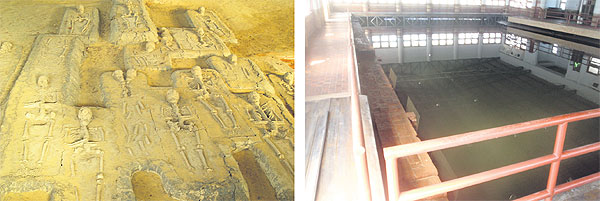
Dozens of skeletons were found at the site of a Portuguese settlement in Ayutthaya in the 1970s. Right, the burial pit as it looks now after waters inundated the area.

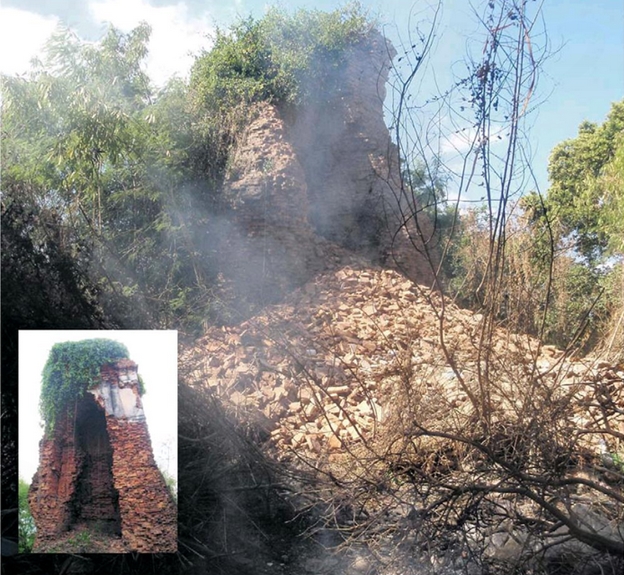
I wondered about this when I discovered that the main memorial tower of one of my favourite deserted temples, Wat Sam Jin, had collapsed into a thousand bricks. 

This ruin was unknown to almost everyone, and now it is gone. It is comforting that I had led many students to this historic site while it stood. We photographed it earlier and created a document of what it once looked like. 

Over time the bricks and artefacts in situ will be carried away by future floods. Wat Sam Jin will likely become a brick mound like dozens of others in the city. 

I also wondered where the bones of Portuguese settlers had floated off to and if any of them had been saved.

showcase – to show the best qualities or parts of something แสดงจุดเด่นของสิ่งของหรือคน
collapse – to fall down suddenly พังลงมา ล้ม, พังครืน

nature takes its course – things that happen according to nature ปล่อยตามเรื่องธรรมชาติ
kayak – to travel using a kayak, a light canoe in which the part where you sit is covered over เดินทางด้วยเรือแคนูขนาดเล็ก

paved – covered with a hard flat surface of pieces of stone, concrete or bricks – ลาดทาง ancient – very old ที่เก่าแก่ ที่โบราณ

modernisation – the process of making a system, methods, etc. more modern and more suitable for use at the present time การทำให้ทันสมัย

exacerbate – to make something worse ทำให้แย่ลง inevitable – unavoidable; certain to happen ซึ่งหลีกเลี่ยงไม่ได้ locals – people who live in a particular place ชาวบ้าน

excessive – much greater than is usual; too much of something มากเกินปริมาณที่พอดี store – to keep for use in the future เก็บ drought – a long period of time when there is little or no water or rain ความแห้งแล้ง artery – an important road, railway, or river เส้นทางหลัก

dredge – to remove unwanted things from the bottom of a river, canal, lake, etc. using a sucking or other device ขุดลอก residents – people who live in a particular area ประชาชนที่อาศัยในท้องที่

stilts – a set of posts that a house is built on to raise it above the ground or above the level of water เสาค้ำ mound – a pile of something, such as earth or stones กองดิน กองหิน seek refuge

 – to try to find a safe place where you can protect yourself from something dangerous or threatening หาที่หลบภัย,หาที่ปลอดภัย in contrast – different from ตรงข้ามกับ

survive – to continue to exist อยู่รอด สืบต่อไปได้ blocked – closed, so that nothing can get through ตัน
landlocked – of a place that has land all around it ที่ล้อมรอบไปด้วยแผ่นดิน

(water) hyacinth – a plant growing in water with large leaves ผักตบชวา rubbish – waste material or things that are no longer wanted or needed ขยะ

reservoir – a natural or artificial lake where water is stored อ่างเก็บน้ำ neighborliness – a particular area of a city or town ละแวก, ย่าน traces – very small amounts of a substance ร่องรอย

topple – to cause to fall คว่ำลงมา construct – to build or make some thing, especially buildings, bridges, etc. สร้าง severe – very serious and worrying ที่รุนแรง ที่น่าเป็นห่วง erode – to rub or be rubbed away gradually กร่อน, กัดกร่อน

monsoon – the seasonal changes Asian countries during which winds shift bringing more rain (southwest monsoon) and less rain(northeast monsoon) มรสุม tropical – relating to the hottest area of the Earth, between the Tropic of Cancer and the Tropic of Capricorn ในเขตร้อน

humidity – the amount of water that is present in the air ความชุ่มชื้น seep – (of a liquid) to flow slowly and in small quantities through something รั่วซึม

looter – someone who steals things from buildings, houses or shops, especially during a war or after a disaster ผู้ปล้นสะดม crack – a line on a surface where something is beginning to break apart รอยแตก รอยร้าว
architecture – in this case, the structure of a building

split – to divide; break apart ทำให้แตกแยก plaster – a substance made of lime, water and sand, that is put on walls and ceilings to give them a smooth hard surface ปูนฉาบผนัง

ruins – the remains of a building that has been badly damaged or destroyed ซากปรักหักพัง shift – to change; to move from one place to another เคลื่อนย้าย

balance – the ability to keep steady with an equal amount of weight on each side ความสมดุล, การทรงตัว
sink – to (cause something or someone to) go down below the surface or to the bottom of a liquid or soft substance จม

due to – because of เนื่องจาก maintenance – the act of keeping something in good condition by checking or repairing it regularly การซ่อมบำรุง site – a place where something is located สถานที่

time-consuming – taking a lot of time to do or finish nevertheless – despite what has just been said or referred to แต่อย่างไรก็ตาม

seek refuge – to try to find a safe place where you can protect yourself from something dangerous or threatening หาที่หลบภัย,หาที่ปลอดภัย

shelter – a place where people are protected from danger or bad weather; a temporary place to stay ที่หลบภัย ที่พักชั่วคราว

crumble – to break, or cause something to break, into small pieces แตกละเอียด function – to perform the action or the job of the thing or person mentioned ทำหน้าที่

huddle – to move close together in order to stay warm เกาะกลุ่มกันไว้ dilapidated – old and in bad condition ซึ่งชำรุดทรุดโทรม

foundation – supporting structure รากฐาน abandoned – left no longer used ที่ถูกละทิ้ง sermon – a talk on a moral or religious subject, usually given by a religious leader during a service การเทศนา

sermon hall – a large, open hall where lay people can hear sermons or receive religious education วิหาร, ศาลาการเปรียญ

host – to provide the space and other things necessary for an activity ทำหน้าที่เป็นเจ้าภาพ belongings – the things you own ข้าวของเครื่องใช้ deserted – empty ที่ถูกทิ้งให้ว่างเปล่า ร้างไป unquestionable – that cannot be doubted ที่ไม่ต้องสงสัย

popular – a situation in which someone or something is liked by many people เป็นที่นิยม, เป็นที่ชื่นชอบ attention – interest, especially interest that the public has in a person, event, situation etc ความสนใจ grandness – the impressive features of something, especially something large ความหรูหรา

remote – far away in distance ห่างไกล scattered – spread over a large area กระจัดกระจาย complex – a large building with various connected rooms or a related group of buildings

memorial – a statue, stone, etc. that is built in order to remind people of an important past event or of a famous person who has died อนุสรณ์

tower – a tall narrow building or part of a building, especially of a church or castle หอสูง,หอคอย,เจดีย์
favourite – something you like the best of all similar things ที่ชอบมาก,ที่โปรดปราน

brick – baked clay used for building walls, houses and other buildings อิฐ document – a paper or set of papers with written or printed information, especially of an official type เอกสาร

artifact – an object that was made a long time ago and is historically important, e.g., a tool or weapon โบราณวัตถุ in situ – in the original or correct place ในแหล่งกำเนิด

skeleton – the structure of bones that supports the body of a person or an animal โครงกระดูก
settlement  a place where people come to live ชุมชน burial – the act of putting a dead body into the ground, or the ceremony connected with this การฝังศพ

inundate – to flood; to submerge ท่วม, ทำให้จมลงใต้น้ำ wonder – to think about something because you want to know more facts or details about it สงสัย settler 

a person who arrives, especially from another country, in a new place and claims the land in order to live on it and farm it ผู้ตั้งถิ่นฐาน

Flood crisis dampens first buyer scheme Only 1,380 applicants since Sept 16 launch


The number of participants in the government's first-car scheme has turned out to be less than expected due to the severe flooding.

A senior Excise Department official said between Sept 16, when the scheme was launched, and Nov 30 the number of applications requesting the excise tax rebate was low at 1,380.

The official, who declined to be named, said the tax rebate requests involved three types of vehicles _ 1,024 passengers cars, 222 one-tonne pickup trucks and 134 double-cab pickup trucks _ for a total rebate amount of 108 million baht.

The widespread flood crisis affecting many northern and central provinces including Bangkok has discouraged participants, said the official.

The damage to the economy from the flooding is expected to be severe, with the National Economic and Social Development Board cutting its gross domestic product projection to only 1.5% from 4.5% expected earlier.

One form the damage will take is in severely reduced purchasing power among consumers.

The crisis has especially hurt the automobile industry by causing disruptions among major car producers worldwide as a result of seven industrial estates serving as production bases for carmakers and auto parts manufacturers being inundated for more than a month.

Some estates have only recently begun cleaning up, while it will take months for each factory to repair the damage to their production lines before they can resume operations.

The Finance Ministry earlier expected 500,000 first-car buyers requesting the tax rebate in the first year of the scheme.

It had estimated the cost of the programme would be as high as 30 billion baht.

Under the scheme, consumers buying their first car under their own name can receive a rebate on the excise tax paid.

The maximum rebate amount is 100,000 baht.

Eligible cars must have an engine size of not more than 1,500cc and be priced at not more than one million baht.

Participants can request the rebate after the ownership transfer. They will receive the amount within a year after applying.

After the flood How to begin cleaning up your home and things to be aware of

When it's time for you to clean up your house after a flood, one of the major health concerns is coming into contact with hazardous household products, like rat poison, insect repellent, pesticides, household cleaners and disinfectants, as well as other harmful chemicals that may have been exposed to the floodwater.


Ideally, these toxic substances should be well-kept in high places. But since the flood level in many areas rose much higher than expected, that may not be the case. Here are some safety procedures you should follow:

All chemical storage bottles and containers, as well as batteries that have been submerged in floodwater must be thrown away.

When dealing with chemical storage bottles or containers, you should always wear rubber gloves and avoid direct contact. 

Put all the bottles or containers in a separate plastic garbage bag and clearly label it so the garbage collector knows what's inside the bag.

Thoroughly clean the area where the bottles or containers were found or where the chemicals may have spilled with clean water. Avoid using chemicals to clean the floor.

People exposed to water that is tainted with chemicals may develop a rash, experience itching or irritation to the eyes. 

Immediately rinse the affected area with water and dry with a clean towel. Then contact the Medical Sciences Department on 02-591-1707.

DANGER OF ELECTROCUTION

Those returning to their houses after a flood should be aware of the risk of electrocution if using electrical appliances that have been wet or damaged by water, or an electrical fire caused by damaged wiring or short circuit. 

If you are unsure the power has been completely cut off from your home or in your area, avoid touching any metal objects, such as doorknobs, locks, fences, lamp poles, etc. 

Always wear thick rubber gloves and rubber boots when checking the circuit breaker. Never touch a circuit breaker that has been submerged in water or exposed to it for a long time. If so, wait for a qualified electrician to deal with it.

Check electrical appliances, cables and sockets for any signs of flood damage. Never use electrical appliances, sockets and wires that have been submerged in water until they have been thoroughly checked by a qualified electrician. Contact the Metropolitan Electricity Authority on 1130.

OTHER FLOOD-INDUCED DISEASES

If possible, open all the doors and windows to allow for proper air ventilation. Besides, sunlight is effective in killing germs and inhibiting bacterial growth. 

Next, clean the dirty and mucky floors and every part of the house. Wash stinky clothes that have been kept in the cupboard and dry them out in the sun to help kill germs.

It's also important that you eat freshly cooked meals and drink clean water to stay in good health and help reduce the impact of communicable diseases post-disaster.

- Mould

It's highly likely people will come into contact with mould on curtains, cupboards, walls, clothes, air-conditioning ducts and carpet after being submerged in dirty floodwater for a long period of time. Green and black mould, in particular, can cause skin problems such as eczema and psoriasis.

It's always better to discard any unimportant/cheap items which have mould on them. To remove mould on furniture or clothing, put them out to dry first or use a fan, then clean them with mould killer solution. Opening all the windows can also help reduce condensation in the house.

Mould on parts of the ceiling or air-conditioning insulation needs to be replaced. Wash all curtains, bedding and blankets using bleach, then disinfect and leave out to completely dry.

- Bacteria

Leptospirosis is an infection caused by bacteria from the genus Leptospira, which can infect both humans and animals. Rats, mice, dogs and cats are among the primary hosts; 

the infection is commonly transmitted to humans when water containing urine from these infected animals come into contact with the skin, in particular, open wounds, the eye, the ear, or through swallowing. The bacteria can last for 30-45 days.

Bacteria can affect the digestive tract which can lead to diarrhoea, typhoid, and dysentery.

To prevent chances of infection, throw away any leftovers and thoroughly clean the floors with disinfectant.

- Parasite

Parasites, such as hookworms, thrive in soil and sand. To avoid them, always wash your hands, especially before meals. Children in particular should avoid putting their dirty hands into their mouth.

Apart from diseases, stress can become a major health concern during and after a flood. It affects people both physically and emotionally. Stress can cause hormonal imbalances of cortisol and DHEA, which is secreted by the adrenal glands. 

This can lead to a lowered immune system. Elderly people and children in particular are venerable to stress, and therefore are more susceptible to diseases. (Information supplied by Kluaynamthai Hospital)

- Poisonous animals

Snakes usually get away when people return home because they don't like any disturbance. Make sure you immediately tidy up the house to ensure there are no mice living in the area, which snakes like to eat.

Always keep your house clean and tidy and let the sunlight in to keep any creepy-crawlies, like centipedes, away.

Also make sure there are no puddles of standing water around the house, which are great breeding grounds for mosquitoes.

Lastly, clear away any dry leaves and grass around the house that may provide shelter for scorpions.


NATURE TAKES ITS COURSE

During the flood, I was able to kayak down paved roads that had once been ancient canals. I could not help but think that modernisation had exacerbated the damage. 

The ancient city had been designed in response to the inevitable seasonal flooding. Locals dug canals for transport and to move excessive water toward areas where it could be stored for times of drought. These arteries were frequently dredged as people used them daily by boat.

The city walls helped to protect residents from rising flood levels. Houses were built on stilts high above the ground. The ancient temples were raised on mounds, and people could seek refuge in them during times of floods.

In contrast, the modern city is not set up to survive large-scale flooding. Many canals are blocked or landlocked by dirt bridges and paved roads. 

Other canals have filled with hyacinth and plastic bags full of rubbish – neither of which existed in the ancient city. Old reservoirs were filled in to create new neighbourhoods, and nearly all traces of the city walls have been toppled. 

New homes are often constructed at ground level, and few locals own boats any more. As a result, the damage is more severe than in the past.

Historic sites are further eroded by monsoonal winds and tropical storms. Rain and humidity seep into holes dug by looters. 

Vegetation growth widens cracks in architecture, causing bricks to split in two and plaster to fall off walls. The ruins gradually shift balance as they sink in mud due to their weight. Maintenance of these historic sites is time-consuming and expensive.

Nevertheless, residents of the modern city often survived floods by seeking refuge at ancient sites. Many set up shelters on the higher ground of crumbled mounds that formerly functioned as temples. 

Animals huddled on the dilapidated foundations of ruins. Long abandoned sermon halls (viharn) hosted families and their belongings. For these people, the value of these deserted ruins is unquestionable.

History loses out to nature

Inset, hidden in a small neighbourhood on the main city island Wat Sam Jin showcased a prang-like chedi. Main photo: Wat Sam Jin after the floods caused it to collapse.

Teacher Ken May has explored just about every square kilometre of Ayutthaya related to old and nearly forgotten historical sites, many of which, he sadly relates, have now been lost to the flood.

Govt promises flood-free future Special water courses costly but necessary

Off to the dump 
Prime Minister Yingluck Shinawatra inspects a flooddevastated area during the Big Cleaning Day in Don Muang district yesterday. Thousands of residents joined the event as authorities declared the district will be completely dry in three to five days. 

The government yesterday promised that economic areas, industrial estates and major cities will be spared from severe flooding next year after national flood prevention measures are completed.

The government's master plan for flood management will be ready shortly, Deputy Prime Minister and Commerce Minister Kittiratt Na-Ranong told a meeting of chambers of commerce nationwide at a hotel in Rayong.

The plan will guarantee that damage from any flooding next year will not be as severe as this year, even if rainfall is equal or to more more than 2011.

Mr Kittiratt said that when the plan is in place, economic zones, industrial estates and major cities would be safe from flooding.

In fact, only limited areas of farmland would be affected by floods and the government would see to it that proper compensation would be paid affected farmers, Mr Kittiratt said.

He said the government will meet with the armed forces and concerned agencies today to discuss plans to build floodways. 

Aerial surveys have been made of areas on the eastern and western sides of the Chao Phraya River to determine possible locations for building the floodways.

Mr Kittiratt said floodway construction would require significant sums and take a long time, although the effort would be worthwhile and could benefit the economy .

Mr Kittiratt added that when construction gets underway, land will have to be expropriated, but the government will try to ensure that impacts from the projects are kept to a minimum.

He said the government will soon reveal a master plan for managing the country's 25 river basins, as well as a short-term water management plan to prepare for the next rainy season, which starts in May.

Other urgent measures include dredging and digging canals, repairing broken sluice gates and keeping count of water pumps. The government will expedite efforts to complete the work in the next five months before the rainy season gets underway.

Mr Kittiratt noted that during the flood crisis, many agencies received funds to purchase water pumps but none of them have produced receipts or showed proof that the money had actually been spent on the devices.

He also tried to allay concerns raised by the private sector about possible corruption in the government's post-flood rehabilitation projects.

He said that former deputy prime minister, Virabongsa Ramangkura, chairman of the government-installed Strategic Committee for Reconstruction and Future Development, would ensure that the funding for the projects will be spent prudently and transparently.

Mr Virabongsa said all of the country's sluice gates will be improved to meet approved standards and that a major drill to regulate the opening and closing of all the sluice gates should be held twice a year.

He said a computerised system would be brought in to regulate sluice gates and replace manpower and ensure there would be enough large water pumps installed in all flood-risk areas.

Mr Virabongsa said he would try to seek financing for all of the projects from domestic sources and that there was no need to borrow from foreign countries.

A survey of 420 executives at the chambers of commerce meeting found that 77% of respondents said the proposed flood management mega-projects were a worthwhile investment, 

University of the Thai Chamber of Commerce vice-rector Saowanee Thairungroj said. A total 75% said construction of floodways should be the top priority, while 59% suggested taxes should be collected to fund flood prevention efforts.

Meanwhile, Prime Minister Yingluck Shinawatra will today hold a special cabinet meeting to review the budget for restoring flood-damaged public facilities and to prevent duplication of projects proposed by various agencies.

To prepare for today's special meeting, Ms Yingluck yesterday met with a few ministers to discuss details of the proposals that will be considered at the special cabinet meeting.

Yesterday's meeting was attended by Interior Minister Yongyuth Wichaidit, Mr Kittiratt and Transport Minister Sukumpol Suwanatat.

Mr Kittiratt said that today's special cabinet meeting will consider abandoning any of the existing state projects that would duplicate the new post-flood rehabilitation projects, such as efforts to repair existing highways or railways.

Mr Kittiratt said the cabinet will also need to ensure that fresh projects to restore flood-hit community enterprises do not duplicate the government's existing village fund projects, or the existing small, medium and large (SML) community development project.

Today's meeting will ensure more clarity in spending on flood recovery, Mr Kittiratt said. Ministers who were not in attendance at yesterday's meeting will have a chance to discuss the plans at today's meeting.

Ms Yingluck said she had instructed all provincial governors to oversee post-flood relief and recovery efforts.

She also told the Interior Ministry to coordinate and integrate flood relief and recovery operations among all concerned ministries to help flood victims in Bangkok.

Low-priced food under the government's Blue Flag scheme will also be carried on trucks for sale around the capital, she said. Also, the government is coordinating with insurance companies to speed up compensation payments for insured vehicles damaged by floods.